
The distribution of costs related to rental appliances is based on a precise legal framework, but many gray areas remain. Article 6 of the law of July 6, 1989, requires the landlord to maintain the equipment mentioned in the lease. The decree of August 26, 1987, lists the repairs that are the tenant’s responsibility.
Between these two texts, the boundary shifts depending on whether the property is rented unfurnished or furnished, the age of the appliance, and what the contract stipulates.
Depreciation Schedule and Appliances: A Lever That Landlords Underestimate
The depreciation schedule attached to the inventory determines the share of costs that remains the tenant’s responsibility at the end of the lease. When applied to appliances, it radically changes the financial distribution.
A refrigerator provided with the furnished accommodation and used for several years undergoes annual depreciation. If the appliance fails, depreciation reduces the tenant’s attributable share, sometimes down to zero. The landlord who has not attached a depreciation schedule to the lease finds themselves without an enforceable scale, complicating any deductions from the security deposit.
We recommend systematically including a specific depreciation schedule for appliances in the furnished lease. The models proposed by collective rental agreements generally set a reference lifespan and an annual depreciation rate. Without this document, the question of who is responsible for the appliances during a return often has to be resolved before the conciliation commission.
The entry inventory must mention each appliance with its working condition, ideally accompanied by dated photos. An imprecise inventory (“washing machine: good condition”) protects neither the landlord nor the tenant in case of a dispute.
Furnished vs. Unfurnished Rentals: Two Distinct Regimes for Appliances
In unfurnished rentals, the owner has no obligation to provide appliances. If they choose to leave a washing machine or refrigerator in the property, mentioning it in the lease creates an obligation to maintain it. An appliance listed in the lease commits the landlord to replace it in case of structural failure.
In furnished rentals, the situation is more stringent. The decree of July 31, 2015, imposes a minimum list of equipment, which includes cooking plates, an oven or microwave, and a refrigerator with a freezer compartment. These appliances are an integral part of the rental service.
Repair or Replacement: The Line of Division
The tenant is responsible for regular maintenance: descaling, cleaning filters, replacing door seals. The landlord bears the costs of repairs related to normal wear and the complete replacement when the appliance is irreparable.
- The replacement of a faulty refrigerator thermostat due to normal wear falls to the owner, as it is a structural part of the appliance
- Unclogging the drain filter of a washing machine is the tenant’s responsibility under regular maintenance defined by the 1987 decree
- The failure of a refrigerator compressor, a component whose replacement cost often exceeds the appliance’s residual value, obliges the landlord to provide a replacement unit
The owner cannot exempt themselves from their replacement obligation by invoking a clause in the lease. Any clause contrary to Article 6 of the 1989 law is deemed unwritten.
Home Insurance and Appliance Failure: Who is Really Covered
The insurance distinction is often overlooked. Only appliances belonging to the tenant are covered by their home insurance. The washing machine that the tenant purchased and installed themselves falls within the scope of their multi-risk home insurance. The built-in oven provided by the landlord does not.
The appliances provided with the property fall under the landlord’s insurance, as they are considered real property by destination. In the event of water damage caused by a defective washing machine supplied by the landlord, it is the landlord’s insurance that covers the appliance itself, while the tenant’s insurance covers damage to the tenant’s personal belongings.
Appliance Failure Options in Multi-Risk Contracts
Several insurers now offer optional guarantees covering appliance failures, with a cap per appliance. Some plans include coverage for the loss of food items in the event of a refrigerator or freezer failure.
This type of guarantee changes the economic arbitration. In cases where the failure does not clearly fall under the landlord’s responsibility (appliance brought by the tenant) nor normal wear, the optional guarantee absorbs the cost without either party bearing it directly.
Lease Clauses and Equipment Not on the List: Contractual Traps
A landlord who provides a dryer in a furnished property when this appliance is not on the minimum regulatory list creates an additional obligation as soon as it is mentioned in the lease and inventory. Removing the appliance during the lease without the tenant’s consent constitutes a breach of the obligation for peaceful enjoyment.
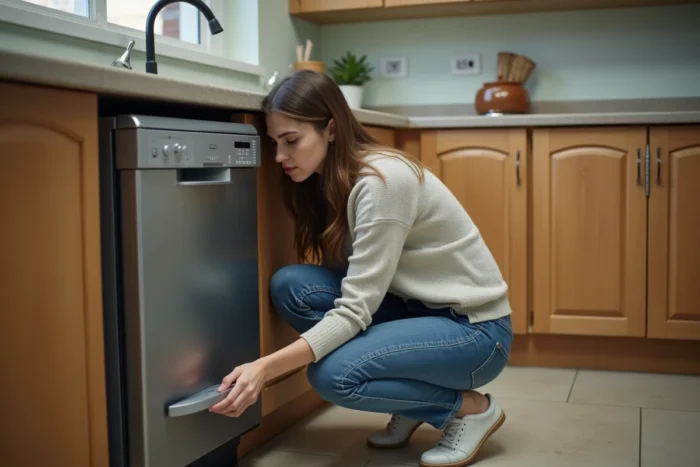
The reverse case also poses a problem. An appliance present in the property but absent from the lease and inventory does not bind the owner. The tenant using it does so at their own risk. We regularly observe disputes related to dishwashers left “graciously” without contractual mention: when they break down, no one wants to pay.
- Any supplied appliance must be specifically listed in the lease and the entry inventory to bind the landlord
- An appliance added by the tenant belongs to them and must be removed at the end of the lease, unless otherwise agreed in writing
- Built-in equipment (oven, hob, hood) is considered real property by destination and remains with the property, not the tenant
The detailed inventory attached to the lease remains the reference document in case of disagreement. Without it, the burden of proof becomes difficult to establish for both parties. Formalizing each appliance with brand, model, and working condition at the start avoids the majority of disputes related to rental appliances.