
The registration of a mobile home does not concern all owners, and this is precisely what creates confusion. A mobile home is legally a Mobile Leisure Residence (RML), which does not circulate on public roads. The question of registration arises only in specific cases, related to transport or resale, and not to daily use on a camping site.
Registration and mobile home: the cases where registration actually applies
A mobile home permanently stationed on a camping plot does not need registration to remain there. The Highway Code prohibits it from moving by its own means. Its movement requires an exceptional convoy, organized by a specialized transporter.
Registration comes into play mainly during transport between two sites or during a resale transaction. The chassis number, engraved on the metal structure of the mobile home, serves as an identification reference, just like a VIN number for a standard vehicle.
Each manufacturer (IRM, Trigano, O’Hara, Louisiane) places this plate in a different location: under the chassis, on the drawbar, or near the front axle. Finding this number is the first concrete step before any administrative procedure related to the registration of a mobile home, because without it, no official document can be established.
| Situation | Registration necessary? | Required document |
|---|---|---|
| Mobile home installed on camping site | No | Plot rental contract |
| Transport to another camping site | Yes (exceptional convoy) | Prefectural authorization + chassis identification |
| Resale between individuals | Depending on the case | Original invoice or transfer certificate |
| Installation on private land (outside authorized area) | Not applicable | Development permit or prior declaration |
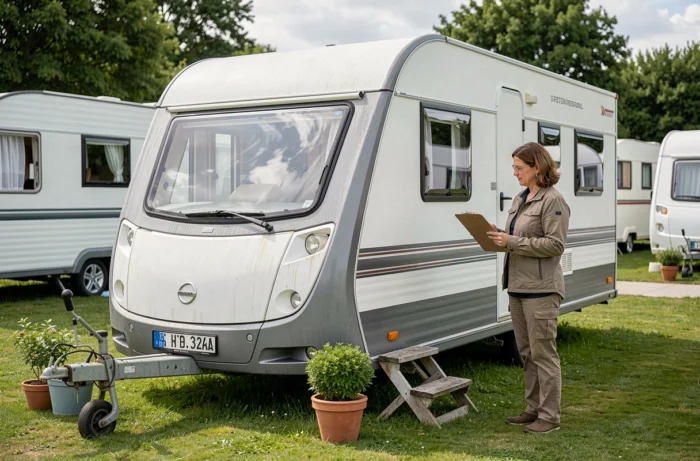
Increased penalties for illegal installation: what changes with the law of November 26, 2025
Most guides on the subject detail the areas where a mobile home can be installed (classified campgrounds, residential leisure parks, holiday villages). What they do not mention is the tightening of penalties since the law of November 26, 2025.
The financial penalties for non-compliance with a formal notice to restore a site have been significantly increased. A mobile home placed outside authorized areas, without the required urban planning permits, exposes the owner to heavier and quicker penalties than before.
Article L.480-4 of the Urban Planning Code provides for a fine of up to €6,000 per square meter of illegally constructed area. Even before initiating any registration or transport procedures, verifying the compliance of the installation site has become a non-negotiable prerequisite.
Tax reclassification of the mobile home: the trap of permanent connection
A mobile home retains its status as a mobile residence as long as it remains movable. Its wheels and drawbar must be kept in working condition. This is a legal obligation, not a recommendation.
The risk arises when the mobile home is permanently stabilized, connected permanently to networks (water, electricity, sanitation), and surrounded by masonry elements such as a sealed terrace or concrete blocks. The tax administration can then reclassify it as a taxable construction, akin to a secondary residence.
This reclassification leads to liability for housing tax, with a potential increase ranging from a few percent to a very significant proportion depending on the municipality. The link with registration is direct: a mobile home whose legal status shifts to that of a construction loses its nature as an RML, and the associated administrative procedures completely change in nature.
- Keep the wheels and drawbar in good condition, even if the mobile home is never moved, to maintain the RML status
- Avoid permanent connections to networks: prefer removable connections
- Do not build a masonry terrace attached to the structure of the mobile home
- Document the mobility status of the mobile home photographically in case of inspection

Chassis number and traceability: checks before purchase or resale
During a transaction, the chassis number is the only reliable identifier of the mobile home. It allows tracing back to the manufacturer, the model year, and the original technical characteristics. Without this number, no legal transfer or transport procedure can be completed.
The original purchase invoice constitutes the title of ownership. In the absence of this document, the situation becomes considerably more complicated, especially for used mobile homes that have changed owners multiple times without written formalization.
Before finalizing a purchase, several points deserve systematic verification:
- Consistency between the number engraved on the chassis and the one on the original invoice
- Existence of a properly executed transfer contract between the seller and the buyer
- Verification that the mobile home is not encumbered by a loan or pledge with a financial institution
- Compliance of the current installation site with the applicable urban planning regulations
LMNP status and mobile home declaration
Owners who rent their mobile home for seasonal use under the status of non-professional furnished rental (LMNP) must declare this activity. The choice between micro-BIC regime and real regime depends on the revenue generated and the chosen tax strategy.
This declaration is distinct from the registration of the mobile home itself, but the two procedures intersect at the time of purchase. The legal status of the mobile home conditions the applicable tax regime, and conversely, the rental project can influence the choice of land and the type of contract with the camping manager.
The difference between a properly documented mobile home and another with unclear traceability is measured at the time of resale or a tax audit. Each administrative document, from the original invoice to the plot contract, forms a coherent set that protects the owner both legally and patrimonially.