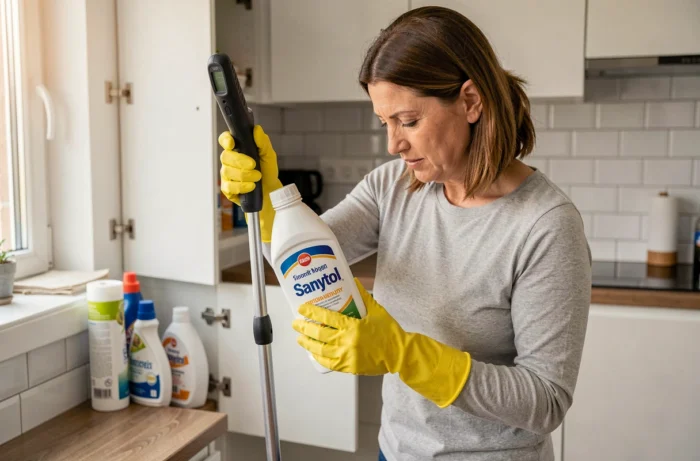
Tineco wet-dry vacuums use a closed-loop system in which clean water mixed with detergent passes through sensitive components before being collected in a dirty-water tank.
Using a third-party product in this system raises a specific technical question: is Sanytol’s formula compatible with the materials and sensors in these appliances? The answer isn’t a simple yes or no, because neither “Sanytol” nor “Tineco” refers to just one product or appliance.
What the Tineco manual actually prohibits (and why)
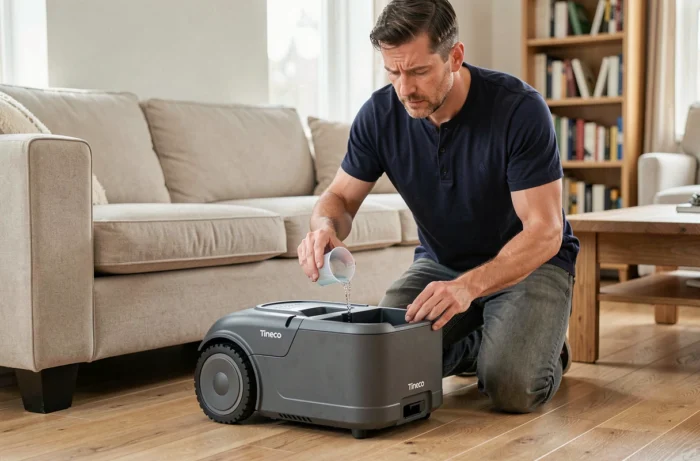
Tineco’s official FAQ advises against pouring any unapproved product into the clean-water tank. This guidance isn’t specific to Sanytol: it applies to all third-party detergents, including white vinegar, black soap and standard multi-surface cleaners.
The manufacturer cites three technical concerns. First, foam can overwhelm the dirty-water tank. For the Floor One S7 Suite, Tineco explains that a third-party solution may quickly fill the tank with excess foam, causing the appliance to shut down or leading to internal overflow.
Second, chemical residue can build up on the smart sensors that regulate water flow and suction power. Finally, using an unapproved product may void the manufacturer’s warranty if the appliance breaks down.
Whether you can replace Tineco cleaning solution with Sanytol should therefore be considered model by model, rather than in general terms. Guidance for the S7 Suite doesn’t necessarily apply to a Floor One S5 or an iFloor 3.
Sanytol in a Tineco: identified compatibility issues
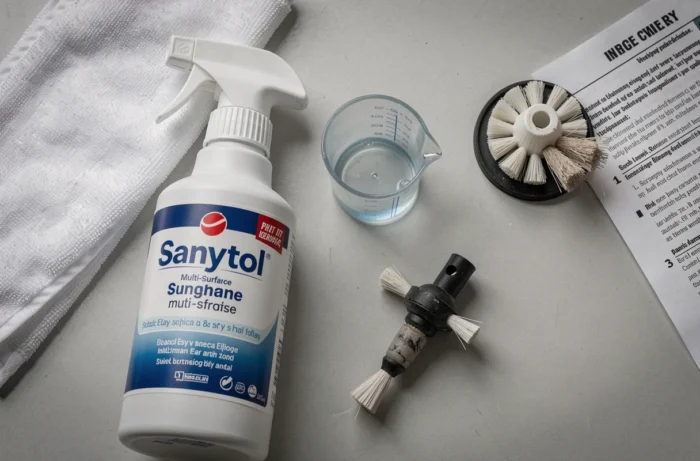
“Sanytol” covers dozens of different products. An eucalyptus-scented multi-surface disinfectant cleaner, a lemon degreaser and a floor disinfectant don’t have the same concentration of active ingredients or foaming properties. Treating “Sanytol” as a single substance is a common mistake in forum discussions.
Foam and surfactants
Sanytol floor cleaners contain surfactants that produce foam when agitated by the rotating brush. In a wet-dry vacuum, that foam has nowhere to go: it rises into the suction system and may reach the motor or HEPA filter. Excessive foaming is the risk most often reported by users who have tried it in Tineco-focused Facebook groups.
Residue on floors
A recurring post in the Official Tineco Fan Club group describes floors becoming slippery after Sanytol was added to the tank. This happens because a wet-dry vacuum doesn’t rinse the floor: it applies the solution and then vacuums it up.
If the detergent leaves a film, it stays on the surface. Tineco’s official solution is formulated to leave no residue without rinsing, unlike standard cleaners designed to be wiped off or rinsed with clean water.
Chemical ingredients and internal seals
Sanytol product information includes precautions for use on certain sensitive surfaces, particularly around pets or young children. These formulas contain biocides, but the manufacturer hasn’t documented their long-term effects on the rubber seals and plastic parts inside a Tineco’s internal system. A lack of data doesn’t mean there’s no risk.
Using a smaller dose: false reassurance?
Several competing articles suggest that half a capful of Sanytol per tank is enough to reduce the risks. This recommendation is widely circulated, but it isn’t based on any tests published by Tineco or Sanytol.
Reducing the dose does reduce the amount of foam produced—that’s a fact. But it doesn’t solve the problem of residue on the floor or chemical compatibility with internal seals. A lower dose reduces a symptom without eliminating the cause.
Also, the “half a capful” recommendation assumes a standard tank capacity. Tineco models don’t all have the same clean-water tank size. Applying one dosing rule to different appliances ignores the specific requirements of each model.
Compatible alternatives for a Tineco wet-dry vacuum
If you’re looking to reduce maintenance costs or disinfect your floors, there are several options that won’t put your appliance at risk:
- Tineco’s official solution (Deodorizing & Cleaning Solution) remains the only option approved by the manufacturer. It costs more per liter than a bottle of Sanytol, but it’s formulated for these appliances’ specific systems and doesn’t produce excessive foam.
- Some generic cleaners made specifically for wet-dry vacuums are available. Their low-foaming formulas make them more suitable than standard household cleaners, although Tineco doesn’t officially approve them.
- Plain water is suitable for routine cleaning on lightly soiled floors. It won’t disinfect, but it protects the appliance and leaves no residue.
If disinfection is a priority (for example, if you have pets or are allergic to dust mites), you can use the wet-dry vacuum with plain water, then apply Sanytol by hand with a mop. Separating mechanical cleaning from chemical disinfection protects the appliance while still meeting your hygiene needs.
Tineco warranty and third-party products: what the terms and conditions say
The “misuse” clause in Tineco’s warranty terms explicitly covers the use of unapproved detergents. If the motor fails, the sensors malfunction or an internal leak occurs, customer service may refuse warranty coverage if traces of a third-party product are found in the system.
This clause doesn’t mean Sanytol will necessarily damage the appliance. It means that the user bears the full financial risk if it breaks down. That’s worth considering when the appliance costs several hundred euros.
The manual for each Tineco model is the definitive reference. Before adding an alternative product to the tank, checking the manual is the only step that relies on the manufacturer’s guidance rather than a forum recommendation.