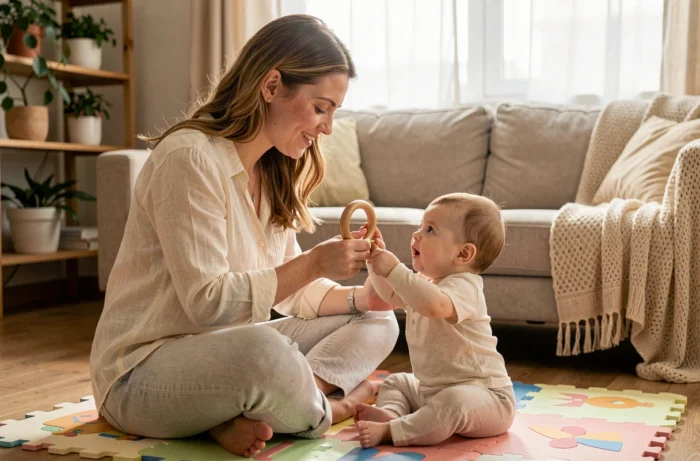
Today’s parents have access to a considerable amount of content on infant development. Sensory toys, educational methods, age-appropriate activity programs: the options are plentiful. However, studies reported by Santé publique France point in a different direction, emphasizing the quality of interactions and the environment rather than the accumulation of activities. This tension between the pressure to stimulate and the need for quiet moments deserves to be clearly articulated.
Baby Development and Technoférence: How Phones Change Interactions
The term “technoférence” refers to the interruption of parent-child exchanges by a digital device. Consulting a screen during a feeding, a diaper change, or playtime diverts attention from the signals the baby emits: gaze, vocalization, hand movements.
The problem is not moral. It is mechanical. A baby who seeks their parent’s gaze and does not find it alters their behavior. They may withdraw or, conversely, intensify their signals to the point of agitation. The availability of parental gaze structures the first interactions.
In practical terms, it is not about banning the phone from the house. The most realistic approach is to identify two or three moments in the day when the device is out of reach: mealtime, bath time, or a period of free play on the floor. These short slots, free from notifications, are sufficient to preserve quality exchanges. To discover Parents Ensemble for baby, additional resources detail these guidelines over the months.
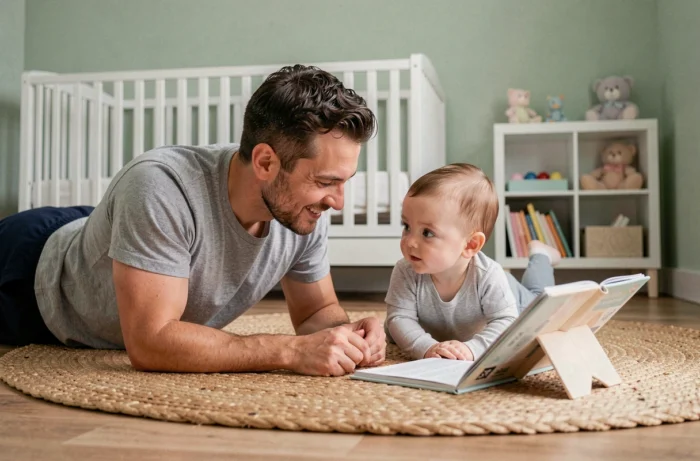
Everyday Environment: Space Matters as Much as Developmental Toys
Articles on baby development often list activities to propose. They rarely address the question of the physical environment in which the infant spends their days. Yet, this is a direct lever on their well-being and motor skills.
A Clear Floor is Better than an Overloaded Play Mat
A baby placed on a firm floor, with a thin mat and a few objects within reach, explores more freely than an infant settled in a bouncer or surrounded by colorful arches. Free space encourages spontaneous movement, rolling over, crawling, and then creeping.
The accumulation of toys in the baby’s field of vision can produce the opposite effect of what is intended. Instead of concentrating, they flit from one thing to another. Two or three objects are sufficient for playtime, provided they vary in texture and weight.
Light, Background Noise, and Temperature
The overall sensory environment plays a role in the infant’s state of alertness. A space that is too brightly lit or constantly noisy (such as a television playing in the background) maintains a level of stimulation that the baby cannot regulate alone. A few concrete adjustments make a difference:
- Reduce continuous sound sources during quiet times, without seeking absolute silence, which does not exist in a lived-in home.
- Favor natural light during the day and dim the lighting in the late afternoon to support the wake-sleep rhythm.
- Observe the baby’s reactions to changes in the environment: yawning, gaze aversion, and agitation often signal sensory overload.
Attentive Presence Without a Program: Supporting Development Without Overloading the Day
Parenting literature multiplies proposals for developmental activities categorized by age. This programming logic can put pressure on parents. If every moment of the day must become an opportunity for stimulation, the risks are twofold: parental exhaustion and overstimulation of the baby.
Observing without intervening is a form of support in its own right. An infant who manipulates a fabric, looks at their hands, or turns their head toward a sound does not need someone to offer them something else. They are already learning.
Sleep, daily rhythms, and parental fatigue benefit from being discussed with a healthcare professional, beyond just motor or language milestones.
Recognizing Pause Signals in the Baby
A baby does not need to cry to express that they have reached their limit. Several signs precede overload:
- Repeated gaze aversion indicates that the infant is trying to cut off the ongoing stimulation.
- Yawning outside of usual sleep times signals fatigue related to the environment, not necessarily a need to sleep.
- Agitation of the limbs associated with high-pitched vocalizations often indicates a rise in sensory tension.
- A baby who brings their hands to their face or rubs their eyes is asking for a reduction in stimulation.
Respecting these signals prevents interpreting physiological needs as mere whims. A parent who notices these signs can simply change rooms, reduce noise, or place the baby in a quiet space.
Realistic Limits for Parents: Baby’s Well-Being Also Depends on Theirs
Recommendations on infant development rarely mention parental fatigue as a variable. Yet, it weighs heavily on the quality of interactions. An exhausted parent forcing a play session produces less fluid exchanges than a rested parent who simply observes their child playing on the floor.
A parent’s rest time is not wasted time for the baby’s development. Placing the child in a safe space and sitting next to them without proposing anything constitutes a sufficient framework. The infant picks up on presence, voice, and micro-expressions of the face, even when no activity is taking place.
The available data on the first 1,000 days emphasizes parental mental health as a factor in the child’s well-being. Transforming this data into practical guidance means accepting that some days consist of feeding, changing, and rocking, without a specific developmental program. Those days count just as much as the others.