The average rating displayed by a property developer on Google or a specialist platform is not enough to assess the quality of its service. What matters is the level of detail in the feedback: reviews aggregated at brand level can hide differences in performance between developments, local offices and stages of the process (sales, construction, handover and after-sales service). Reading customer reviews of a property developer takes a methodical approach, not just a quick glance at an overall rating.
How regulations affect the reliability of online reviews for buyers
Since 28 May 2022, professionals publishing reviews in France have been required to state whether reviews are verified, how they are ranked and what grounds may justify refusing to publish them. These requirements, set out in the French Consumer Code, apply to property developers that display testimonials on their website or through a third-party review collector.
The absence of this information is a weak but useful warning sign. A property developer that promotes “verified” reviews without explaining how they are verified is operating in a grey area. DGCCRF inspections confirm that irregularities involving reviews remain common across all sectors, and regulations have increased penalties for misleading online practices.
In practice, when you analyse reviews of Franco Suisse as a property developer or any other company, first check whether the platform clearly explains its moderation policy. A transparent review collection process carries more weight than a large number of testimonials with no clear source.
Reviews by property development: the only level of detail that matters

A national property developer may deliver an exemplary development in Lyon while leaving numerous outstanding defects on a project in Bordeaux. A developer’s overall rating does not reflect the reality of a specific development. That is why specialist platforms now break down feedback by project.
Three factors can help you make sense of reviews for each development:
- The ratio of reviews posted during the sales phase to those posted after handover. A developer that only asks customers for feedback when they sign captures satisfaction with the purchase, not with the quality of construction. Post-handover reviews are the most revealing.
- Recurring negative comments about the same issues on a particular development (delays, soundproofing, finishes). An isolated defect may be a one-off. Three reviews highlighting the same problem point to a systemic failure.
- The developer’s responses to negative reviews. A detailed reply offering a solution indicates an active after-sales service team. A generic copy-and-paste response suggests reputation management without any operational follow-up.
We find that buyers who cross-check reviews for each development against actual handover times get a much more reliable picture than those who rely on the brand’s overall rating.
Customer satisfaction with off-plan purchases: when dissatisfaction takes hold
Buying off-plan creates a particular tension because the customer pays for a property that does not yet exist. Dissatisfaction tends to build during three specific stages: construction, handover and the resolution of defects. Negative reviews most often appear in that order.
During construction, complaints mainly concern a lack of communication from the developer. A construction project running late is not always a sign of incompetence, but a developer that leaves buyers without updates for months is.
At handover, discrepancies between the original plans and the finished property account for most negative reviews. According to the UFC Que Choisir study cited by EDinstitut, fewer than half of customers say they are satisfied with their property developer. Although this figure is not specific to any one company, it reflects a standard of service that the industry rarely achieves.
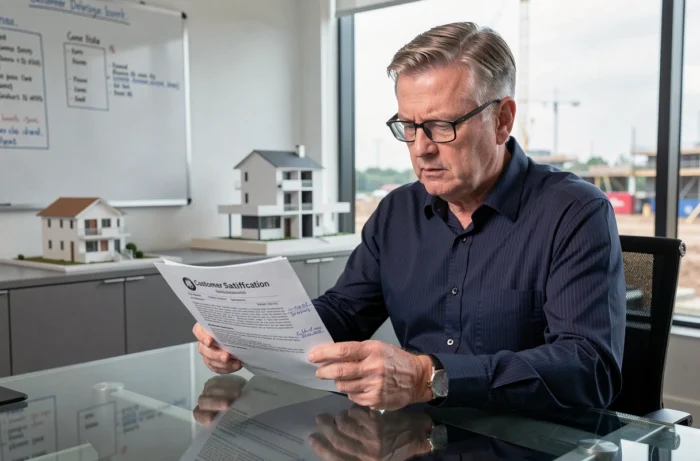
Resolving defects after the keys have been handed over is the real test. A developer that addresses defects within a reasonable timeframe and without repeated reminders stands out clearly in customer reviews. By contrast, an unresponsive after-sales service can turn a dissatisfied customer into an active critic on every platform.
A property developer’s online reputation: separating signal from noise
Developer rankings based on Google reviews, such as Leanco’s ranking based on more than 10,000 reviews collected in March 2025, provide a useful but incomplete overview. The number of reviews and the average rating are not enough without analysing their written content.
Two developers can have the same rating of 3.8/5 but radically different profiles. One may receive polarised reviews (lots of 5-star ratings during the sales phase and lots of 1-star ratings after handover), while the other gets consistently similar ratings of around 4. The second profile points to a more consistent quality of service.
To filter out the noise, focus on reviews that mention verifiable facts: the development’s name, handover date, nature of the problem and response received. Purely emotional reviews, whether positive or negative, provide no useful information for assessing a developer’s reliability on your project.
One final point is often overlooked: the date of the reviews. If a developer’s negative feedback is concentrated in the past and more recent reviews are improving, it has probably corrected its processes. The opposite trend—a gradual decline—should be far more concerning than a one-off low rating.