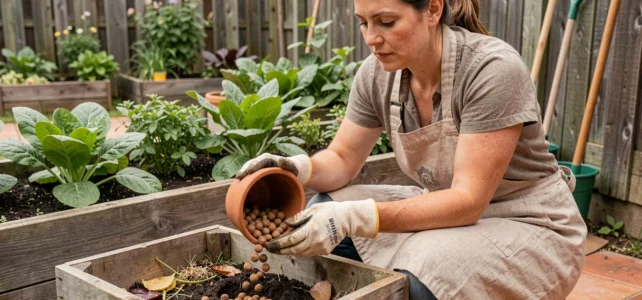
Clay balls have finished their service at the bottom of the pot and you don’t know what to do with them. Throwing them in the regular trash seems logical, but this action poses a real regulatory and ecological problem. These small spheres, fired at high temperatures, are considered inert waste, just like bricks or tiles. Their disposal therefore follows specific rules.
Clay balls and inert waste: a classification that changes everything
Have you noticed that clay balls do not decompose, even after several seasons outdoors? This is precisely what makes them problematic once used. Baked clay does not biodegrade. It remains stable for decades in the soil without releasing toxic substances, but also without breaking down.
In the European waste nomenclature, baked clay balls belong to the family of inert materials (chapter 17, alongside bricks, tiles, and ceramics). This classification means they are prohibited in household waste bins, even in small quantities. Mixing them with regular waste disrupts sorting chains and unnecessarily increases the volumes directed towards landfilling.
Since the generalization of source sorting of bio-waste at the end of 2023, local authorities insist on separating mineral fractions. Specifically, clay balls must go to the inert waste stream, not the green bin or bulky waste. To find out exactly where to throw clay balls, you first need to identify the appropriate bin at your local recycling center.
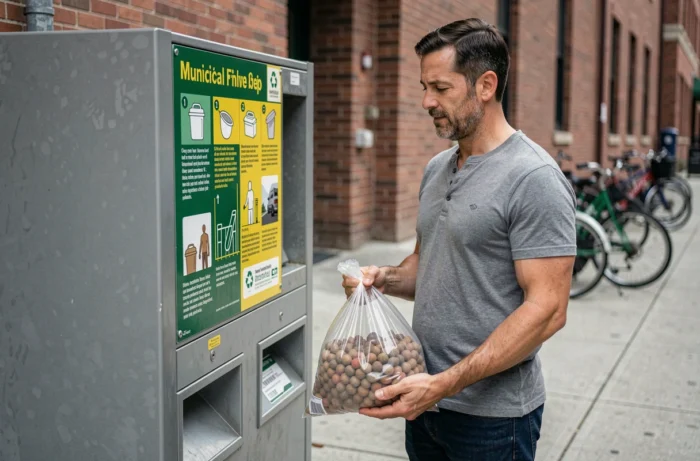
Recycling center: the “rubble and inert” bin for your used clay balls
The recycling center remains the most reliable solution. Look for the bin reserved for rubble or inert materials. This is where you also deposit pieces of tiles, broken bricks, and concrete remnants.
Before you go, a few practical precautions deserve attention:
- Separate the clay balls from the potting soil or roots that accompany them. The topsoil and organic residues go into another bin (green waste or soil).
- Place the balls in a sturdy bag, like a rubble bag. Their weight, even for a single pot, can be surprising.
- Check the hours and access conditions of your recycling center on your intercommunity’s website. Some limit the volumes of inert waste per visit.
Never dump clay balls in nature or in a watercourse. Their accumulation prevents vegetation from rooting and alters the surface structure of the soil. A wild deposit of inert materials is also an offense.
Reuse clay balls in the garden before throwing them away
Before considering the recycling center, ask yourself a simple question: are these balls really at the end of their life? Expanded clay retains its drainage properties for many years. A simple cleaning often suffices to give them a second life.
Cleaning and reactivating for drainage
Rinse the balls under clear water in a colander or sieve. Scrub them to remove limestone deposits or root residues. Rinsed balls regain their drainage capacity and can return to the bottom of a pot or planter without any notable loss of effectiveness.
If they have been in contact with a sick plant (fungus, root pests), soaking them in a solution of water and white vinegar for a few hours limits the risks of cross-contamination.
Mineral mulching on the surface of pots or beds
Clay balls work very well as mulch at the base of plants. Placed on the potting soil, they limit evaporation and maintain a more consistent moisture level at the roots.
This reuse is particularly suitable for indoor plants and container shrubs on a terrace. Mulching with clay balls reduces the frequency of watering without altering the substrate deeply.
Alternatives to clay balls to reduce inert waste
If managing used clay balls annoys you, other materials serve the same drainage role with a simpler end of life.
- Pumice, a natural volcanic rock, offers comparable drainage. It fragments slowly and can be directly incorporated into the soil at the end of its use.
- Perlite, also of volcanic origin, lightens the substrate and improves aeration. It eventually breaks down into fine particles that mix with the potting soil.
- Shards of broken pottery, recycled at the bottom of pots, provide an effective drainage layer and do not generate additional waste.
None of these options are perfect. Pumice remains a material extracted from quarries. Perlite requires energy-intensive industrial processing. The choice depends on what you are growing and the amount of substrate you handle each season.
Avoid accumulation: buy the right amount of clay balls
The problem of “what to do with them” often arises from excessive purchasing. Bags of clay balls sold at garden centers start at volumes intended for large planters or terrace boxes. For two or three indoor pots, a single bag can last for years.
Calculating the actual volume needed before purchase avoids surplus. A drainage layer at the bottom of a standard pot does not exceed two to three centimeters in thickness. In practice, a small bag covers the needs for several repottings.
Clay balls can be stored indefinitely in a dry place. Instead of buying new ones each spring, store those you recover during repottings in a closed bucket. This simple reflex reduces both expenses and the volume of inert waste to manage at the end of the process.