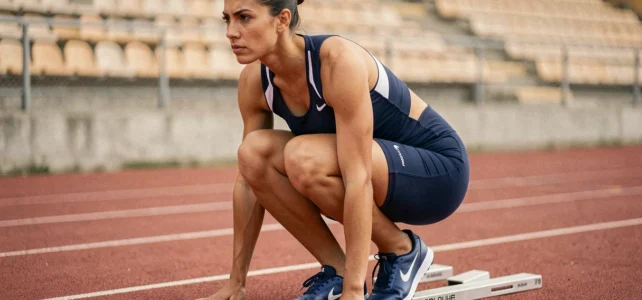
Maryse Éwanjé-Épée, frequently searched under the spelling “Maryse Evan Jeppe,” remains one of the most prominent high jumpers in French athletics. Her French record, longevity at the highest level, and transition into television sports commentary form a career that few French athletes can claim.
Biomechanical Analysis of Maryse Éwanjé-Épée’s High Jump
Maryse Éwanjé-Épée’s high jump technique relied on a particularly explosive take-off phase. Her ability to convert horizontal speed into vertical elevation, combined with an uncommon back flexibility, allowed her to regularly clear bars close to the two-meter mark.
Her personal best of 1.96 meters reflects mastery of the Fosbury flop, where the positioning of her hips above the bar was optimized to the nearest centimeter. We observe in her a height-to-vertical jump ratio that placed her at the top of the European spectrum of her time.
This performance, maintained over several seasons, was not a statistical accident. It reflected a structured training regimen focused on plyometrics, strengthening hip extensors, and calibrated run-up work. The photos of young Maryse Evan Jeppe show an athlete with a long-limbed physique, typical of jumpers capable of performing beyond 1.90 meters.
French Record in High Jump: An Exceptional Longevity
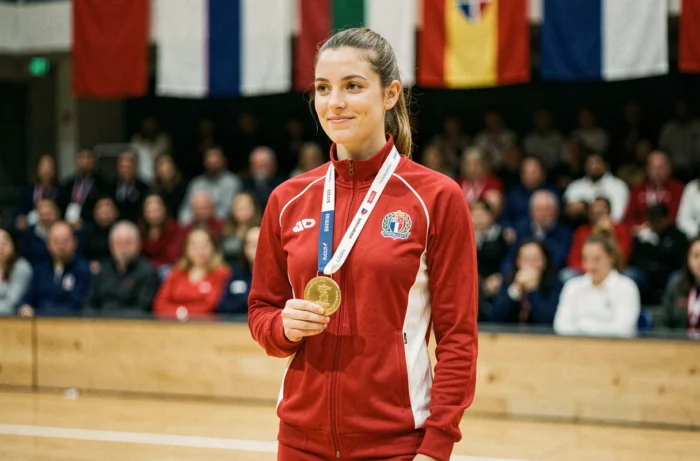
The women’s French record remained in her hands for over two decades. This duration of holding the record places Maryse Éwanjé-Épée in a unique category. Most national records in women’s high jump are broken in less than ten years in major athletics nations.
The relative stagnation of women’s high jump in France after her peak can be explained by several factors: a smaller pool of jumpers compared to sprinting or middle-distance running, a lack of specialized training structures, and the technical difficulty inherent to the discipline. High jump requires a combination of athletic qualities (speed, jump, coordination) that few French female athletes have gathered since.
International Achievements and European Medals
Continental competitions have been the preferred arena for Maryse Éwanjé-Épée. Her results in European championships confirmed a consistency at the highest level, with finals contested against the best specialists from Eastern Europe, who were dominant in the discipline.
The familial aspect deserves mention: her sister Monique Éwanjé-Épée also achieved results at the European level. This family duo represents a rare case in French athletics, where two members of the same sibling perform simultaneously at the highest international level in the same discipline.
Maryse Éwanjé-Épée, Athletics Consultant on France Télévisions
Maryse Éwanjé-Épée’s media transition is not limited to a few occasional appearances. We see a steady rise in her role within the editorial framework of France Télévisions, particularly since recent major events:
- World Athletics Championships in Budapest in 2023, where she joined the team of consultants alongside Stéphane Diagana
- 2024 Paris Olympic Games, an event that highlighted her technical expertise to a broader audience
- European Championships in Rome 2024, and then Birmingham 2026, where she comments daily on events with Alexandre Pasteur and Benoît Durand
Her live analysis stands out for a biomechanical reading of jumps and races that few television consultants offer. The experience of a former French record holder brings immediate technical credibility during high jump or hurdles commentary.
Club President and Commitment to Athletes in Difficulty
Beyond the microphone, Maryse Éwanjé-Épée serves as president of an athletics club in Noisy-le-Grand. This role places her in direct contact with the realities on the ground: training young athletes, managing facilities, seeking funding.
In 2023, she publicly got involved in the case of hurdler Dimitri Bascou, who had launched a crowdfunding campaign to prepare for the Olympic challenges. Maryse Éwanjé-Épée openly criticized the lack of support from the French Athletics Federation for certain high-level athletes. The situation took a different turn with Bascou’s subsequent suspension for doping, but the issue of funding for French athletes remains a structural topic that her intervention helped to highlight.
A Positioning Between Field and Media
This dual role (club president and television consultant) gives Maryse Éwanjé-Épée a cross-sectional view of French sport. She understands the budget constraints of clubs, the training pathways for young athletes, and the demands of high-level competition.
This hybrid profile explains the relevance of her media interventions. When she comments on a high jump final in Birmingham, she does not only discuss technique: she understands the training journey, the sacrifices, and the shortcomings of the federal system that have led each athlete to the starting line.
The French athlete whose name is so often misspelled occupies a unique place in the landscape of hexagonal athletics. A former record holder, club leader, and television voice of major championships, Maryse Éwanjé-Épée embodies a rare form of continuity between the track and post-career.