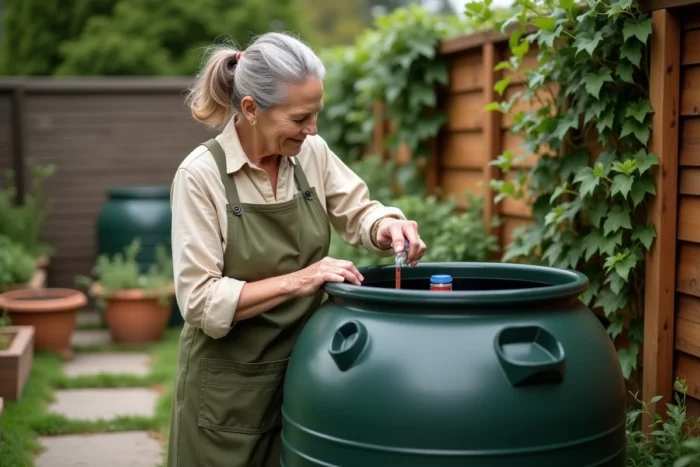
A recovery tank installed for a few months, water that starts to smell, a greenish film on the surface: this scenario is common. The shelf life of rainwater depends less on the container than on what happens inside, between bacterial proliferation, exposure to light, and prolonged stagnation. Some technical choices, often simple, can radically change the quality of the stored water.
Why rainwater degrades in the tank
Rainwater is relatively pure when it falls. The problem begins as soon as it runs off the roof. It carries with it organic residues, dust, pollen, and sometimes bird droppings. These materials end up in the tank and serve as food for microorganisms.
Two factors accelerate degradation: light and heat promote algae proliferation. A translucent tank exposed to the sun will see its water turn green within a few weeks. In contrast, an opaque, buried tank maintains a low and stable temperature, which significantly slows bacterial development.
Stagnation also plays a direct role. Water that does not circulate for several weeks accumulates sediments at the bottom. These deposits create an anaerobic environment (without oxygen) where bacteria produce sulfur compounds, responsible for the rotten egg smell.
To find tips for maintaining a rainwater collector and understand these mechanisms in detail, it is essential to first grasp this triptych of light-heat-stagnation.
Upstream filtration: the action that extends storage duration
Have you noticed a muddy deposit at the bottom of your tank after a few months? This sediment comes directly from unfiltered debris at the entrance. A pre-filter on the gutter removes leaves, moss, and large debris before they reach the tank.
This pre-filter is not always sufficient. A fine filter, installed between the downspout and the tank, retains smaller particles (sand, pollen). Without this second level of filtration, dissolved organic matter feeds microorganisms even in a perfectly opaque tank.
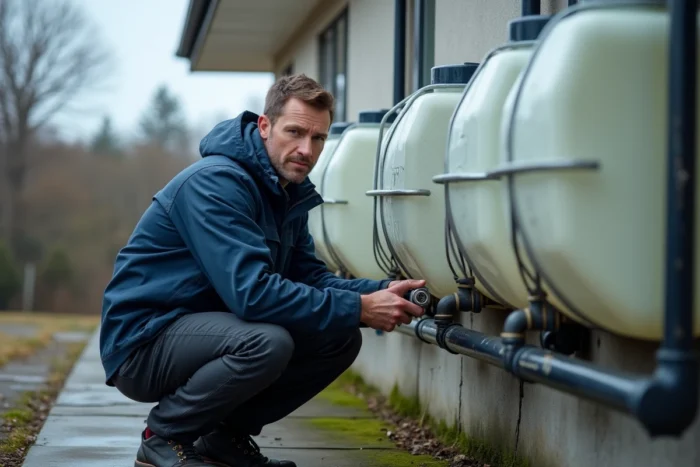
The collector-filter with a “first flush” system provides an additional benefit. The principle is simple: the first liters of rain, which are most contaminated after a dry period, are diverted to the drainage system. The water that enters the tank afterward is significantly cleaner.
- Gutter pre-filter with grid: retains leaves and insects, to be cleaned after each significant rain event
- Fine filter (mesh of a few hundred microns): blocks sand and pollen, to be rinsed once a month during the collection season
- First flush device: automatically diverts the first dirty liters, to be purged regularly
These three combined levels significantly reduce the organic load in the tank. Less organic matter means water that remains healthy for longer, sometimes several months without intervention.
Opaque and buried tank: temperature as a conservation ally
The choice of container is as important as filtration. An above-ground translucent plastic tank placed in full sunlight meets all the conditions for rapid degradation. Light nourishes algae, and summer heat accelerates every biological reaction.
A buried tank maintains the water between 10 and 15 °C all year round. At this temperature, bacteria multiply much more slowly than at 25 or 30 °C. If burial is not possible, at least opt for a completely opaque tank placed in the shade, ideally against a north-facing wall.
The material also matters. High-density polyethylene (HDPE) tanks resist UV rays and do not let light through. Concrete tanks offer an additional advantage: they slightly neutralize the acidity of rainwater, which limits the corrosion of pumps and metal fittings.
Sizing and water rotation
An oversized tank compared to your actual needs poses a concrete problem: the water stagnates too long. If you use the water only for summer irrigation but your tank fills up as early as autumn, several months of storage without withdrawal degrade the quality.
The ideal is to size the tank to cover two to five weeks of autonomy based on your consumption. Some recent technical guides recommend this ratio to ensure regular renewal. Water that circulates and renews is preserved better than stagnant water, even in a perfectly equipped tank.
New domestic uses and conservation: what the 2026 decree changes
The new French decree of 2026 on rainwater paves the way for washing laundry with rainwater, provided that an appropriate treatment chain is established. Pre-filtering, fine filtration, and UV disinfection become necessary before the washing machine.
This extension of use changes the game for conservation. Watering the garden tolerates water stored for several weeks without special treatment. Washing laundry requires water of nearly immediate quality after treatment, with microbiological risks, odors, and deposits on textiles if the chain is not respected.
In practice, if you are considering these domestic uses, the acceptable storage duration without continuous treatment decreases. A recirculating UV system or additional disinfection becomes the logical extension of the tank.
Tank maintenance: frequencies and concrete actions
Filtering and proper storage do not exempt you from regular maintenance. At least once a year, the tank must be drained and cleaned. The accumulated sediments at the bottom create a breeding ground for anaerobic bacteria.
- Complete draining and cleaning of the tank once a year, ideally at the end of winter before the irrigation season
- Inspection and rinsing of filters every month during the active collection period
- Checking the overflow and the anti-insect mesh at each change of season
- Visual inspection of the water (color, odor, surface deposits) every two weeks in summer
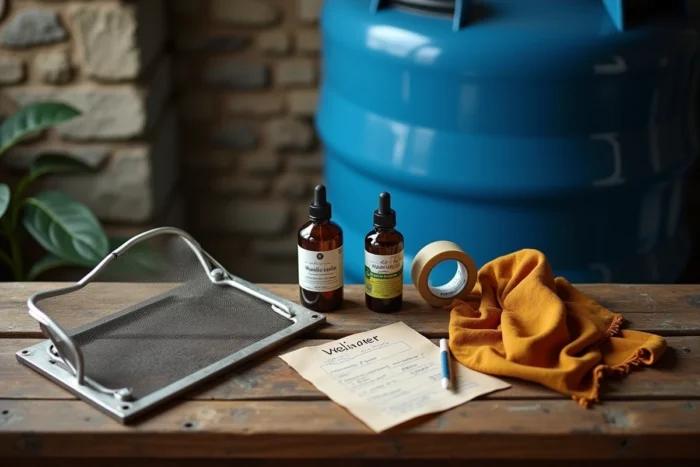
The mesh on the overflow is not a cosmetic detail. Without it, mosquitoes lay eggs in the tank, and the larvae accelerate the biological degradation of the water. A fine mesh at each opening is enough to block this vector.
Rigorous maintenance extends preservation by several months. In contrast, a neglected tank for two years produces unusable water even for irrigation, with a stubborn biofilm on the walls that re-contaminates clean water as soon as it is refilled.
The shelf life of rainwater does not have a universal fixed value. It depends on the filtration at the entrance, the opacity and temperature of the tank, regular renewal, and the rigor of maintenance. With a well-designed system, the water remains usable for the garden and cleaning for several months.
For the domestic uses opened by the 2026 decree, the treatment chain must be active and continuous. The notion of “long-term storage” then becomes a question of daily maintenance.