
A tenant leaves their accommodation on a Friday evening, hands the keys directly to the landlord, but no document is signed. Three weeks later, the owner disputes the return date and withholds an additional month’s rent.
This scenario, common in rental management, can be resolved with a simple paper signed by both parties. The key handover letter against signature clearly sets out the precise moment when the tenant ceases to be responsible for the property, and when the landlord regains possession.
Exact time and meter readings: two details that no one thinks to add
Most templates available online focus on the handover date, the property’s address, and the list of keys. Two elements that can change everything in case of a dispute are often overlooked.
The first is the exact time of the key handover. Mentioning “March 15” is not enough when water damage occurs on the evening of the same day. By specifying the time (for example, 2:30 PM), the tenant’s responsibility is limited to the exact minute. This precision avoids gray areas regarding the effective date of the handover.
The second is the readings of the water, electricity, and gas meters taken at the time of handover. To go further, one can note the PDL (point of delivery) references for electricity and PCE (point of counting and estimation) for gas. These numbers allow the energy supplier to unambiguously identify the meter and avoid any cross-billing between the old and new tenants.
When looking for a key handover against signature template ready to use, it is best to check that these two details are included before printing it.

Drafting the key handover certificate: the details that really matter
You don’t need a lawyer to draft this document. A blank sheet and a pen are enough, provided you don’t forget any of the following information.
- The full identity of both parties: name, first name, current address of the tenant, and contact details of the landlord (or the representative if there is one).
- The precise address of the property concerned, including the floor, lot number, or door if the building has several.
- The date and time of the handover, followed by a detailed list of the returned keys: number of front door keys, mailbox keys, access badges, cellar or parking keys.
- The readings of the meters recorded on-site (cold water, hot water, electricity, gas), along with the serial numbers or PDL/PCE references.
- The explicit mention that both parties acknowledge the effective handover, followed by each party’s handwritten signature.
A often overlooked point: initial each page of the document when the certificate spans multiple sheets. This precaution prevents any additions after the fact. You sign at the bottom, initial in the margin of each sheet, and each party keeps an original copy.
Key handover by electronic signature: a valid option under certain conditions
When the landlord lives several hundred kilometers away or the handover is done through a representative, one wonders if a dematerialized version holds the same value. The answer is yes, provided the framework set by the eIDAS regulation on electronic identification is respected.
In practice, a qualified or advanced electronic signature is sufficient to give the document evidentiary force. Public tools (like DocuSign, Yousign) offer compliant signature levels, but it is essential to verify that the provider issues a traceable certificate. A simple checkbox in an email does not constitute an electronic signature under the regulation.
Reactions vary on this point: some landlords prefer paper out of habit, while others have used electronic signatures for years without issue. The key remains that the document is signed by both parties and stored in a non-modifiable format (signed PDF, for example).
Key handover in shared accommodation: identifying each occupant and each set of keys
Shared accommodation complicates matters. If three roommates each have a set of keys, the certificate must list who returns what by name. A global document with a single signature protects no one.
The best practice is to write a line for each roommate detailing the keys returned: two front door keys, one parking badge, one mailbox key, for example. Each occupant signs next to their line. If a roommate leaves before the others (individual departure in a collective lease), a separate certificate is established for them alone, dated and signed by the landlord.
This precaution avoids internal disputes. When the security deposit is withheld for missing keys, it is necessary to prove who returned their set and who did not.
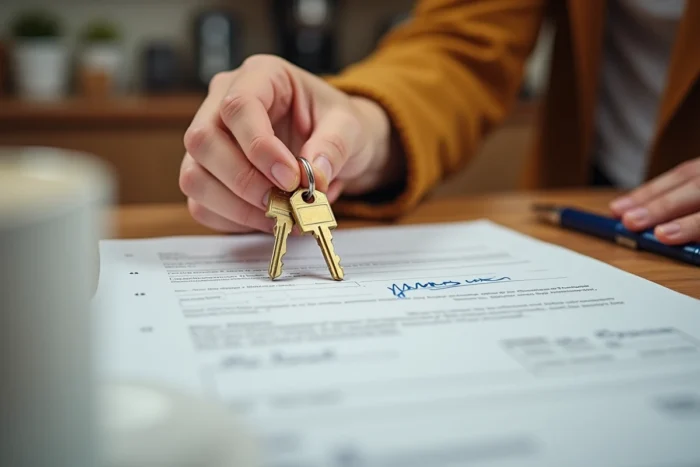
Link between key handover certificate and return of the security deposit
The date on the key handover certificate triggers the legal deadline for the return of the security deposit. If the exit inventory is compliant, the landlord has one month from this date to return the amount. In case of justified deductions (damages, unpaid rent), the deadline extends to two months.
Without a signed certificate, proving the effective return date becomes very difficult. The landlord can argue that the keys were not returned or that the handover took place later. The tenant finds themselves without proof, and the process to recover their security deposit becomes significantly longer.
Keeping the original of this certificate for several years remains the best protection, for both the tenant and the landlord. A document of a few lines, signed on the day, is enough to defuse most disputes related to the end of the lease.