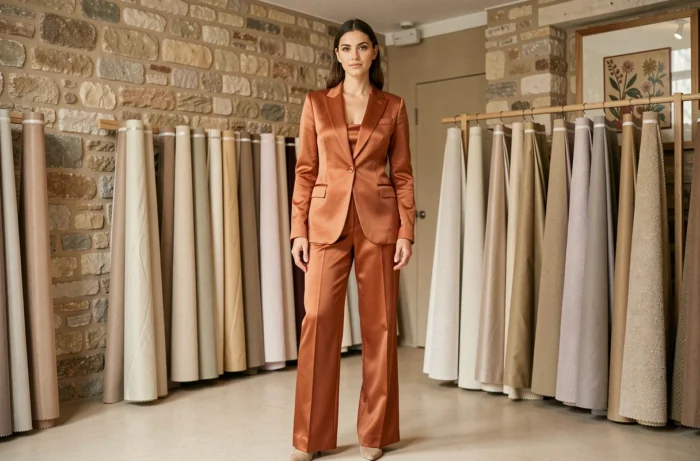
The Mango women’s suit for a wedding relies on a balance between the construction of the jacket, choice of fabric, and color harmony. Failing to get one of these three parameters right turns a ceremony outfit into office wear. Here, we detail the technical points that distinguish a suit truly suited for a chic wedding from a suit simply worn out of a professional context.
Fabric weight and weave: the technical filter before any aesthetic choice
A fabric that is too light buckles under the seams of the jacket. A fabric that is too heavy prevents the fluid drape expected for a summer ceremony. We recommend systematically checking the composition and weight before considering color or cut.
For an outdoor wedding between May and September, viscose-linen or viscose-polyester blends with a sufficiently dense weight without excessive rigidity offer a compromise between the jacket’s structure and thermal comfort. Crepe remains a safe bet for indoor ceremonies or mid-season events, as its grainy weave masks faux creases and captures light without synthetic reflections.
At Mango, the ceremony collections regularly include fluid fabric blazers and matching trousers for a total look. The “Suits” category in the Total Look section allows filtering for coordinated sets, but we notice that product sheets do not always mention the exact weight. Feeling the fabric in-store or consulting detailed reviews remains the most reliable method for assessing the actual drape.
Choosing a Mango women’s chic wedding suit requires looking beyond the product photo and focusing on the material before the silhouette.
Mango jacket construction: what distinguishes a ceremony blazer from an office blazer
The jacket makes or breaks the suit. In ready-to-wear, the difference between a structured office blazer and a wedding-appropriate blazer lies in three construction elements that are often invisible in photos.
Shoulders and interfacing
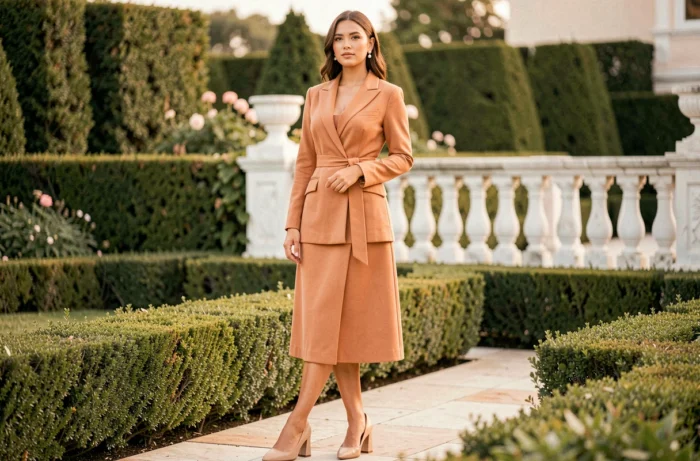
The shoulder determines the entire line of the bust. A shoulder that is too square with a rigid shoulder pad evokes corporate attire. For a wedding, we prefer jackets with a natural or slightly structured shoulder, without a pronounced rise. Mango offers double-breasted blazers with belts and fitted models whose shoulder line varies by collection.
The interfacing (the intermediate layer between the outer fabric and the lining) conditions the flexibility of the drape. A classic fusible interfacing is sufficient for an everyday blazer. For a ceremony where the jacket is worn for several hours, partial interfacing or the absence of interfacing on fluid models ensures more freedom of movement.
Jacket length and proportions
A jacket that stops at the waist is suitable for silhouettes that want to visually elongate the legs, especially with high-waisted trousers. A mid-length jacket (below the hip) better balances A-shaped body types or taller silhouettes. At Mango, fitted blazers are generally cut at the waist, while double-breasted models fall slightly lower.
- Short jacket (above the hip): ideal with palazzo trousers or a midi skirt to create a marked waistline
- Mid-length jacket (below the hip): balances wide hips and structures long silhouettes that lack volume
- Oversized deconstructed jacket: to be avoided at weddings, as it leans too easily towards casual
Color palette suitable for a wedding: beyond beige and black
Black at ceremonies is always divisive. In practice, an all-black suit without texture breaks or bright accessories struggles to pass the daytime wedding test. However, a black suit enhanced by a light satin top or a gold accessory radically changes the game.
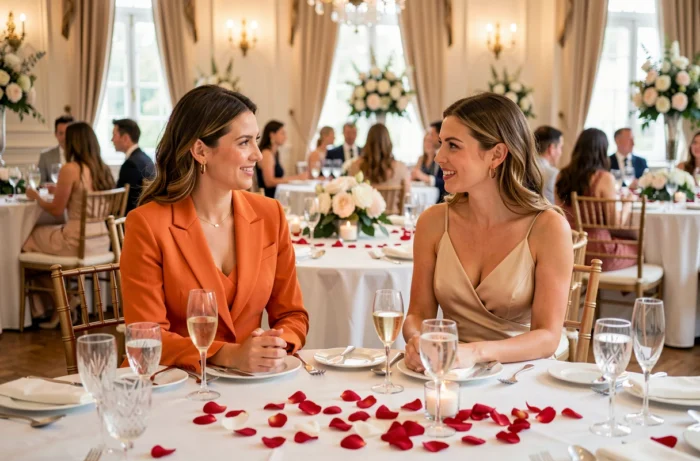
Mango develops its ceremony ranges around several chromatic axes. Neutral tones (beige, ecru, greige) work for rustic or bohemian weddings. Saturated shades like fuchsia or garnet (present in the current blazer collection) add character without crossing the line into eccentricity.
Monochromatic shades, such as a chocolate brown ensemble, create an immediate effect of sophistication because they eliminate the issue of matching top and bottom. The total monochromatic look simplifies accessorizing and refocuses attention on the cut rather than the colors.
- Pastel tones (lavender, powder pink, sage green): suitable for spring and summer weddings, easy to accessorize with gold metals
- Saturated warm tones (terracotta, fuchsia, burgundy): best rendered in autumn-winter, require makeup and shoes in the same thermal register
- Dark neutrals (navy, anthracite, black): acceptable if the fabric has a satin or textured appearance that avoids a corporate look
Pantsuit or skirt suit Mango: decide based on the venue and dress code
The pantsuit dominates searches, but the midi skirt suit remains technically more versatile for outdoor ceremonies with uneven terrain (garden, estate, adapted beach). The fluid midi skirt adapts to movement and tolerates temperature variations better than fitted trousers.
The palazzo pants paired with a fitted blazer is the most photographed combination this season. This duo works as long as the pants are long enough to brush the top of the shoe without dragging on the ground. Planning hem alterations before the big day avoids unpleasant surprises.
For a civil wedding followed by a short cocktail, the fluid fabric pantsuit offers a modern look without breaking the style. For a religious ceremony followed by a long reception, the midi skirt suit allows for more adjustments (removing the jacket in the evening, adjusting with a belt). The choice depends as much on the venue as on the day’s schedule.
One last technical point often overlooked: the lining of the pants or skirt. An unlined bottom in a lightweight fabric sticks to tights and creates transparency effects under certain lighting. Checking for at least a partial lining on the front of the garment avoids this inconvenience on the day of the ceremony.