
Bull bile is a natural stain remover used for centuries on textiles. Its application on leather raises more specific questions: what types of stains does it actually treat, on which leathers can it be applied without risk, and how does it compare to cleaners formulated for conservation? The answers vary depending on the nature of the leather and the desired outcome.
Lipases and bile acids: the chemical mechanism of bile on leather
Bull bile is a substance extracted from the gallbladder of cattle. Its composition is based on two families of active molecules: bile acids (cholic acid and taurocholic acid) and lipase-type enzymes.
Bile acids act as natural surfactants. They disperse greasy substances by emulsifying them in water, which helps to dislodge oily stains embedded in the fibers of the leather. Lipases, on the other hand, break down fats through enzymatic hydrolysis.
Bile also contains lipid substances that dissolve certain dyes. This property, exploited in the visual arts for dispersing pigments in watercolor and gouache, explains why bile soap can alter the color of delicate leathers. For anyone interested in the translation of bull bile into Arabic or its traditional uses, this dual degreasing and dispersing action forms the basis of its effectiveness.
Bull bile compared to pH-neutral leather cleaners
The two approaches do not meet the same needs. The table below summarizes the differences based on the criteria that matter for regular maintenance.
| Criterion | Bull bile soap | pH-neutral cleaner (conservation) |
|---|---|---|
| Degreasing action | Strong (lipases + bile acids) | Moderate, controlled |
| Risk to color | Can dissolve certain dyes | Formulated to preserve colors |
| Sensitive leathers (aniline, nubuck) | Not recommended without prior testing | Suitable after localized testing |
| Thick leathers (saddle, belt, full-grain bag) | Effective on stubborn stains | Sufficient for regular maintenance |
| Usage recommended by restorers | Not recommended routinely on old leathers | Recommended by conservation guides |
| Origin | Animal by-product (bovine bile) | Synthetic or plant-based depending on brands |
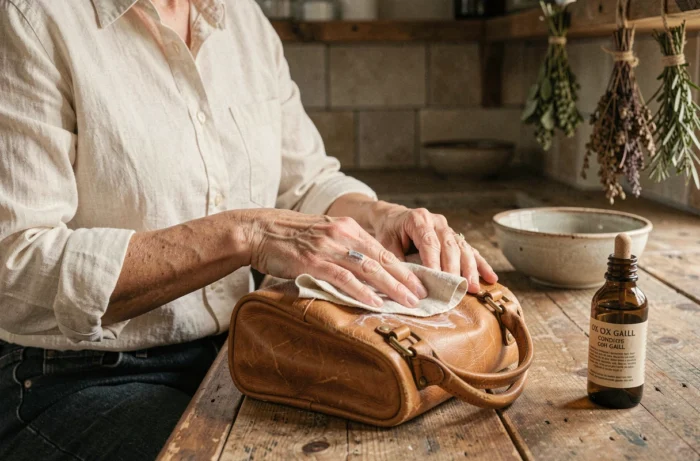
Leather conservation guides in heritage institutions advise against routinely using bile soaps on old or sensitive leathers. They recommend pH-neutral cleaners formulated for conservation, with a systematic test on a discreet area before any application.
On the other hand, on robust full-grain leather (travel bag, hiking shoe, riding saddle), bull bile remains a formidable spot cleaner against greasy or organic stains that mild cleaners struggle to dislodge.
Compatible leathers and leathers at risk with bull bile
The distinction is based on the type of tanning and the finish of the leather. Pigmented leather withstands bile better than aniline leather, whose surface directly absorbs active agents without a protective layer.
- Pigmented full-grain leathers (dress shoes, common leather goods): bile can be applied without major risk, provided it is rinsed quickly and the leather is nourished afterward with an appropriate cream.
- Aniline and semi-aniline leathers: bile can irreversibly alter the color. A test on a hidden area (inside the tongue, underside of the flap) is mandatory.
- Nubuck and suede: the sanded structure of these leathers makes them very vulnerable to powerful surfactants. Bull bile should be avoided.
- Old leathers, acid leathers, or parchments: heritage restorers exclude bile from their protocols. The risk of degradation outweighs the cleaning benefit.
The common point of these restrictions is the pH of bile, slightly alkaline, which can destabilize tannins and accelerate the aging of already weakened leathers.
Plant-based alternatives and vegan labels: questioning bull bile
In recent years, several leather care and household product brands have reformulated their lines to offer ranges without animal by-products. The PETA-Approved Vegan and The Vegan Society labels, whose charters have recently been updated, explicitly require the absence of animal bile in certified formulations.
This pressure is pushing some manufacturers to replace bile with plant-based surfactants in their textile and shoe cleaners. Bile then remains only in ranges labeled “traditional,” not certified.
For leather care, these plant-based alternatives rely on degreasing agents derived from coconut oil or sugar beet. Their stain-removing power is generally milder, making them compatible with a wider range of leathers, including aniline leathers. However, against a deeply embedded mechanical grease stain, plant-based surfactants often require multiple applications where bile acts in one application.
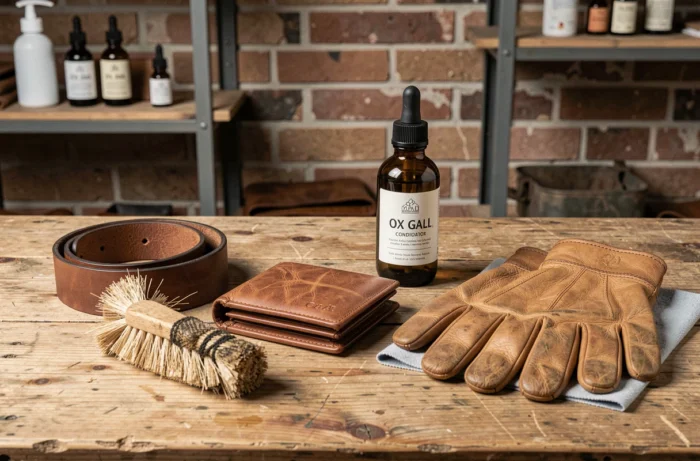
Application protocol for bull bile on full-grain leather
For compatible leathers, the application method is as important as the product itself.
- Dust the leather with a dry cloth or a soft brush to prevent abrasive particles from scratching the surface during cleaning.
- Lightly dampen a clean cloth and apply a small amount of bile soap. Rub the stain in circular motions, without soaking the leather.
- Immediately rinse with a clean damp cloth to remove any residue of bile. Prolonged exposure increases the risk of discoloration.
- Let air dry, away from any direct heat source. Wet leather is vulnerable to deformation.
- Apply a nourishing cream or leather balm once the surface is dry. Bile deeply degreases: without rehydration, the leather will dry out and crack.
This last point is often overlooked. Bull bile removes fats, including those that maintain the natural flexibility of leather. Cleaning without nourishing weakens the material instead of protecting it.
Bull bile remains relevant as a spot cleaner on robust leathers, provided its limits are respected. On sensitive or old leathers, pH-neutral cleaners offer a safety-efficiency ratio that bile cannot match. The choice depends less on the product than on the leather to which it is applied.