The surface area of a vegetable garden for two people varies greatly according to different sources. The figures range from a few square meters to several dozen, without always specifying the level of experience or the actual time available. For a beginner couple, the sizing is less about a theoretical yield calculation and more about a question of manageable workload in the first year.
Maintenance time per square meter: the factor that guides overlook
Most recommendations start from the food needs to define the surface area. A couple eats a certain number of kilos of vegetables per year, so they need a certain number of square meters. This reasoning overlooks a crucial parameter for beginners: maintenance time.
Weeding, watering, pruning, harvesting, pest management: each square meter of vegetable garden requires regular attention. A beginner almost always underestimates this burden. Field reports vary on this point, but online gardening communities highlight a recurring pattern: a garden that is too large in the first year leads to abandonment before the end of summer.
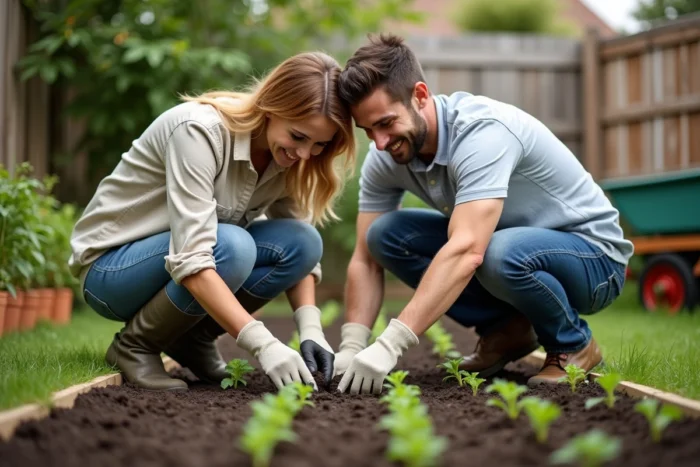
10 to 15 m² in the first year is a reasonable estimate, not to meet the food needs of a couple, but to allow for learning without discouragement. The idea is to gradually expand in the following seasons, once the tasks are mastered. You can discover Le Jardin de Gaïa to delve deeper into this gradual scaling logic suitable for beginners.
Beginner vegetable garden area: why aiming for self-sufficiency from the start is a mistake
Complete food self-sufficiency in vegetables for two people requires a surface area much larger than what an inexperienced couple can manage. Aiming for this self-sufficiency from the first season confuses the final goal with the starting point.
A well-organized vegetable garden of 10 to 20 m² will not make a couple self-sufficient. It will produce some of the vegetables consumed in summer, a few staggered harvests if the crops are well chosen, and most importantly, a concrete experience of the plant cycle. This foundation then allows for doubling or tripling the area with informed knowledge.
The common pitfall is planting too many varieties from the start. Five or six different vegetables are more than enough in the first year. Tomatoes, zucchini, and beans are among the most suitable crops for beginners, as they are more forgiving of watering or fertilization mistakes.
Heatwaves and drought: adapting the size of the garden to the current climate
Episodes of extreme heat and recurring drought change the game for sizing a vegetable garden. One square meter of soil exposed to the sun in mid-summer requires regular watering, sometimes daily depending on the type of soil and region.
For a beginner couple without an automatic irrigation system, each additional square meter increases the watering burden. Gardening trainers now recommend limiting the cultivated area in summer for novices, focusing efforts on a few water-intensive crops rather than spreading water over a large plot.
This climatic constraint reinforces the argument for a modest starting area. It is better to have a small garden that is well-watered than a large garden stressed by a lack of water, where the plants produce little and become sick.
Mulching and ground cover: reducing watering without reducing surface area
Mulching remains the most accessible technique to limit evaporation. A layer of straw, dead leaves, or shredded material on bare soil significantly reduces water needs and slows the growth of weeds.
For a beginner, properly mulching a 15 m² garden is manageable. Beyond that, the amount of organic material to find and transport becomes a project in itself. This logistical detail is rarely mentioned but weighs heavily in the actual sizing.
Which vegetables to grow in a small garden for 2 people
The choice of crops is as crucial to success as the area itself. Some vegetables take up a lot of space for modest yields, while others produce abundantly in just a few square meters.
- Tomatoes remain the most common choice: three to four plants are sufficient for a couple, covering about 2 to 3 m² including the necessary spacing.
- Zucchini are productive but invasive: two plants easily occupy 3 m² and provide more than a couple can consume in peak season.
- Climbing green beans utilize vertical space and free up ground area, making them particularly suitable for small spaces.
- Lettuce and radishes grow quickly and can be sown successively, allowing for multiple harvests in the same space during the season.
- Herbs (basil, parsley, chives) take up very little space and can be integrated between rows of vegetables.
Conversely, potatoes, cabbages, or winter squash require a lot of space for a yield that does not justify sacrificing area in a small garden.
Square garden or in-ground: what setup to start with
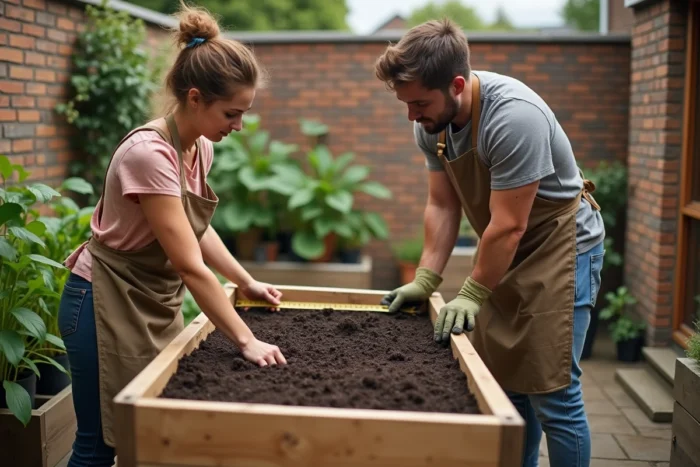
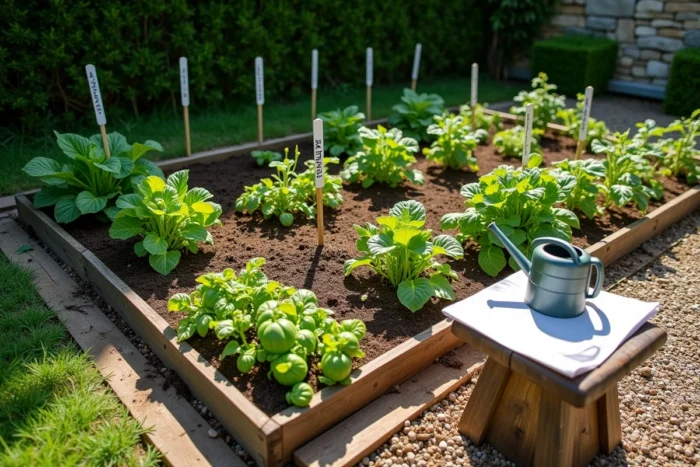
The raised square garden appeals to beginners for its structured and aesthetic aspect. It has real advantages: the soil is better from the start (you make it yourself), weeding is reduced, and the work is done at a more comfortable height.
However, raised garden beds limit the usable area relative to the investment. Four squares of 1.20 m on each side represent less than 6 m² of cultivation for a significant cost in wood, potting soil, and compost. In-ground gardening, if the soil is decent, offers more flexibility for gradual expansion.
For a couple with a garden, even a small one, in-ground gardening is often the most pragmatic choice. A rectangle of 3 m by 5 m, well-exposed to the south or southwest, with easy access to a water source, is sufficient for a complete first season.
- Exposure: at least six hours of direct sunlight per day for summer crops (tomatoes, zucchini, beans).
- Access to water: a tap or a rainwater tank nearby; otherwise, watering quickly becomes a hassle.
- Distance from the house: a garden visible from the kitchen or terrace will be better monitored than one relegated to the back of the yard.
A well-placed 15 m² garden produces more than a poorly placed 30 m² garden. The area is only part of the equation. The location, soil, and time you are willing to dedicate each week determine the outcome as much as the square meters.