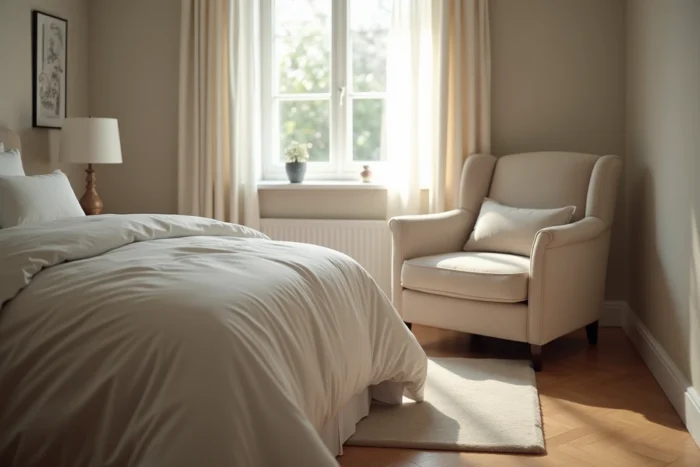
You have a reading chair positioned facing the bed, and for the past few weeks, sleep has been more elusive. Coincidence or not, the question of sleeping facing a chair often comes up in discussions about bedroom layout. Between beliefs related to feng shui and concrete mechanisms documented by sleep therapists, we sift through the information.
Chair Facing the Bed and Negative Conditioning for Sleep
Before discussing feng shui or bed orientation, a psychological mechanism deserves attention. CBT-I protocols (Cognitive Behavioral Therapy for Insomnia) are based on a simple principle: the brain associates the bed with what it sees from the bed. If the direct field of vision includes a reading chair, an office chair, or any furniture related to daytime activities, the brain maintains a state of alertness at bedtime.
This mechanism has a name: stimulus control. The American Academy of Sleep Medicine recommends removing any elements from the visual field that remind one of wakefulness. A chair facing the bed, even if comfortable, can maintain a mental association between the bed and alertness.
This logic is also found in the recommendations of the INRS in France, which advises against placing “office” or “visitor” type chairs in the bedroom facing the bed, as this maintains a constant connection with work and encourages rumination at bedtime. Understanding why to avoid sleeping in front of a chair according to CréAgencement helps grasp the link between furniture arrangement and sleep quality.
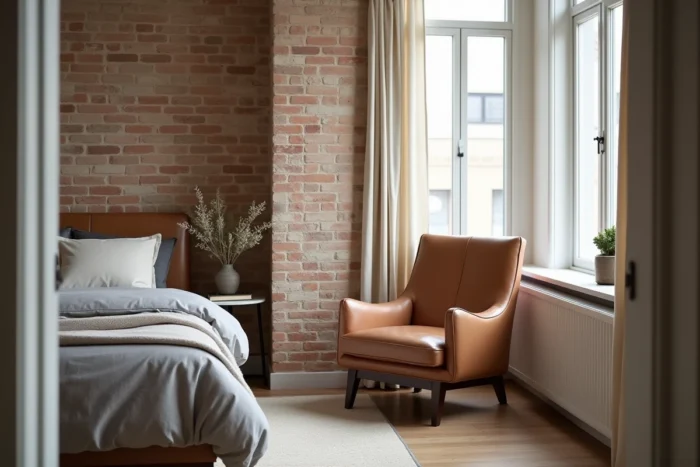
Feng Shui and Bed Position: What Really Concerns the Chair
Feng shui recommends placing the bed in a “command position”: against a solid wall, with a clear view of the door without being directly aligned with it. In this logic, a chair placed between the bed and the door blocks the flow of qi and creates what practitioners call an obstacle in the room’s energy flow.
In practice, feng shui does not specifically treat a chair facing the bed as a formal prohibition. The discipline is more concerned with the relationship between the bed, the door, and the windows. A chair becomes problematic when it obstructs the main circulation axis or when it introduces a yang element (activity, work) into a space meant to remain yin (rest, calm).
What Vastu Shastra Adds to the Discussion
Vastu shastra, an Indian architectural tradition, emphasizes the direction in which one sleeps (preferably with the head to the south or east). Regarding furniture facing the bed, vastu recommends keeping the space in front of the sleeper as clear as possible to avoid hindering morning energy. A massive chair in this axis is seen as a hindrance to vitality upon waking.
Feedback varies on this point among practitioners, but the principle of visual clearance at the foot of the bed is a consensus in both traditions.
Concrete Bedroom Layout: Where to Place the Chair
Rather than banishing the chair from the bedroom (sometimes the space doesn’t allow for that), one can rethink its placement. Here are the configurations that work best to preserve sleep quality:
- Place the chair against a side wall, perpendicular to the bed, so that it is out of direct visual range when lying down
- Orient the chair towards the window rather than towards the bed, breaking the line of visual confrontation
- Create a symbolic separation with a small piece of furniture, a plant, or a rug that delineates a reading corner distinct from the rest area
- Prefer a chair with soft lines and neutral colors rather than an office chair, to avoid any association with work
The goal is not to mechanically apply a feng shui rule. It is to eliminate the visual stimulus that keeps the brain in active mode at bedtime.
Light and Clutter: Two Aggravating Factors
A chair facing the bed poses more problems when the room is small and cluttered. In a limited space, imposing furniture facing the bed accentuates the feeling of confinement, which harms rest.
Light also plays a role. If the chair is located between the bed and the window, it casts a silhouette in the room at night, especially in urban areas with external lighting. This cast shadow can fragment sleep for those sensitive to light variations.

Sleeping Facing a Chair: Superstition or Real Sleep Problem
The popular belief surrounding the empty chair facing the bed (associated in some cultures with the idea that an entity could sit there at night) obviously has no measurable basis. However, the discomfort it causes for some sleepers is not trivial. An object perceived as threatening in the bedroom is enough to raise the level of nighttime vigilance, even unconsciously.
Sleep therapists do not speak of superstition but of environmental perception. An empty chair facing the bed, in the dark, can activate an inherited surveillance reflex. For anxious sleepers, moving this chair or covering it with a blanket may be enough to reduce this tension.
The starting point remains the same: observe your own reaction. If you have been sleeping well with a chair facing the bed for years, moving it out of principle makes no sense. If your nights have deteriorated after a rearrangement, testing a new furniture arrangement for two weeks is the most reliable method to isolate the cause. Sleep reacts to the visual environment much more than one might assume.