Water at 60 degrees Celsius corresponds to a precise threshold where the liquid is too hot to keep your hand in for more than a second, yet still far from boiling. This temperature is important for both the health safety of the hot water tank and the preparation of certain beverages or laundry washing. Reaching this benchmark without a thermometer is possible, provided you understand the physical indicators of water and the limitations of each method.
Legionella and hot water: why 60 degrees is a regulatory threshold
Most articles on measuring water at 60 degrees focus on tea or cooking. They overlook a heavier issue: the prevention of legionellosis risk. Legionella, bacteria that naturally occur in water systems, proliferate within a warm temperature range. Above 60 degrees, their development is halted.
According to the ARS Grand Est, the temperature of hot water must be maintained at least at 50 degrees and at most at 60 degrees at the kitchen sink. This framework aims to limit contamination from shower aerosols, the main route of domestic infection.
In practical terms, if the thermostat of the hot water tank is set too low, bacteria multiply in the tank and pipes. If set too high, the risk of burns increases and energy consumption rises. The ability to measure water at 60 degrees at the tap allows you to verify that the water heater setting corresponds to this health window.
Kitchen thermometer and digital probe: the reliable method
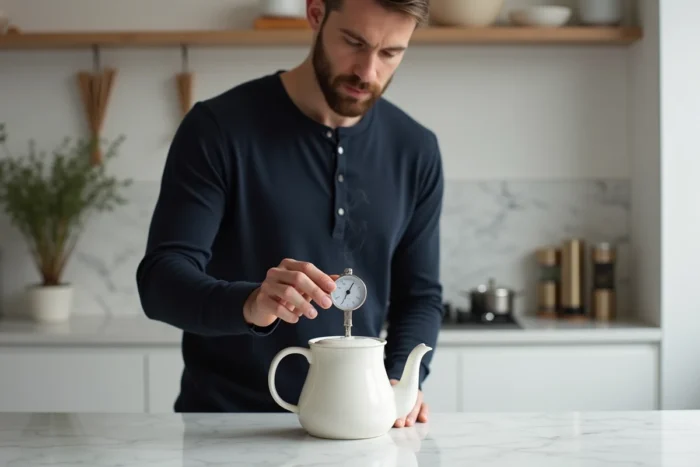
The most direct means remains the digital probe thermometer. Models sold for kitchen use display the temperature within seconds with an accuracy of one to two degrees. For a correct measurement, the probe must be immersed in the water without touching the walls of the container or the bottom, which can skew the reading.
Infrared thermometers (non-contact) measure surface temperature. On a liquid, the surface may be slightly cooler than the core of the volume. Their reliability remains acceptable for a quick check, but the submerged probe provides a result that is more representative of the actual water temperature.
Points to check before using a thermometer
- The measurement range should cover at least 0 to 100 degrees Celsius for versatile use in cooking and plumbing.
- The probe must be waterproof and designed for immersion, not just splash-resistant.
- A quick calibration in melting ice (0 degrees) helps detect any offset in the device.
Some devices show significant discrepancies between the actual temperature and the indicated one. Checking your thermometer in ice water before relying on it is a step that few people take, even though it only takes a few minutes.
Estimating water temperature without a thermometer: visual and tactile cues
Without an instrument, precision decreases significantly. Any estimation remains approximate, with a margin of error of ten degrees or more. Keeping this limit in mind prevents blind reliance on a sensory method for sanitary use.
The tactile test with the wrist or elbow
At 60 degrees, the water causes an almost immediate burning sensation if you plunge your hand in. The elbow test, classic for bathing infants, works around 37 degrees. At 60 degrees, the elbow perceives a distinctly painful heat. This test confirms that you are well beyond lukewarm, but does not provide an exploitable number.
Visual cues in the pot
Observing the water as it heats provides some useful indicators:
- Small bubbles form on the bottom of the container well before boiling, typically between 50 and 70 degrees. At 60 degrees, these bubbles remain stuck to the bottom and do not yet rise in a continuous chain.
- Light steam begins to rise from the surface, without the water bubbling.
- The container becomes too hot to hold with bare hands, but the water itself shows no visible movement on the surface.
These visual cues give a rough estimate. For preparing green tea or certain herbal teas, this approximation is sufficient. For setting a hot water tank, it does not replace an instrumental measurement.
Adjusting the water heater thermostat: controlling the temperature at the source
The majority of hot water tanks have a mechanical or electronic thermostat. The recommended setting is between 55 and 60 degrees, a range that balances bacterial prevention and energy consumption management.
On an electric water heater with a mechanical thermostat, the dial does not always have degree graduations. In this case, the only verification possible is through a measurement at the tap closest to the tank, after a few minutes of drawing. If the water comes out below 50 degrees or above 65 degrees, an adjustment of the thermostat is necessary.
Tip for water heaters without a digital display
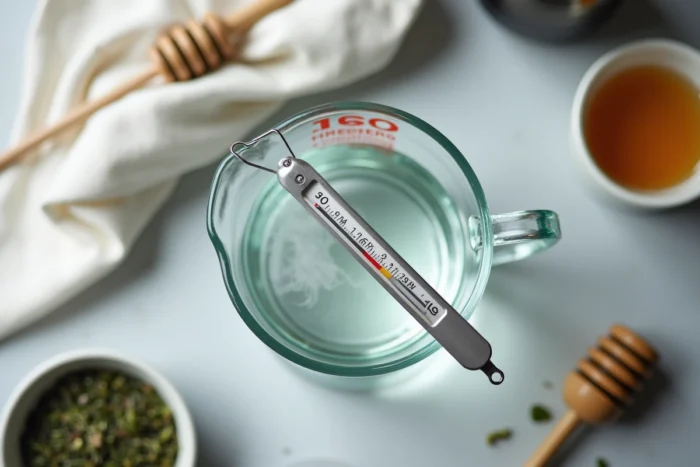
Open the hot water tap in the kitchen (often the closest to the tank), let it run for two minutes to stabilize the temperature, then measure with a probe. This operation, repeated once or twice a year, is sufficient to detect any drift in the thermostat. A faulty thermostat can maintain the water at too low a temperature without anything being visible from the outside.
The issue of water temperature goes beyond simple comfort. Between preventing legionella, the electricity consumption of the water heater, and the quality of tea infusion, the benchmark of 60 degrees recurs with a regularity that justifies investing in a reliable probe thermometer. A few euros and a measurement each season are enough to secure the entire hot water circuit of a home.