We’ve all witnessed that moment when a parent stands up, microphone in hand, and loses their composure after just three sentences. The text was written, rehearsed the night before in the kitchen. The problem wasn’t the content or nerves, but a concrete trap: wanting to say everything in one speech. Preparing an emotional wedding speech for one’s son requires more sorting work than writing.
Choose a single emotion before writing the wedding speech
Most parents who freeze in front of a blank page share the same reflex: listing everything they want to express. Pride, nostalgia, humor, gratitude, life advice. The result is a text that skims over each feeling without delving into any.
The effective approach, documented by several public speaking coaches, is based on a dominant emotion defined from the start. Pride in having watched a child grow up, or tenderness linked to a specific shared memory. This unique emotion becomes the guiding thread of the speech, and each sentence returns to it.
Writing a wedding speech for one’s son around a clear axis also avoids a common pitfall: the sudden leap from a childhood anecdote to solemn marital advice, which destabilizes both the speaker and the audience.
Filter anecdotes: the rule of unknown memories for the guests
We think we’re doing well by accumulating memories. His first steps, the day he lost his first tooth, the graduation ceremony. The problem is that the guests already know half of these stories. Parents have told them at every family meal for twenty years.
A simple criterion allows for sorting: keep only an anecdote that the majority of the audience is hearing for the first time. A moment shared between two, a discreet exchange, a situation where the groom’s character was revealed without him knowing.
This unique anecdote creates a surprise effect. Guests listen because they learn something new. The groom is touched because he realizes that this moment mattered to his parent too. It’s this contrast that produces emotion, not the accumulation of generic compliments.
- Test the anecdote on someone who is not part of the close family: if this person smiles or asks a question, the memory works
- Limit the speech to one or two anecdotes maximum, developed with sensory details (a place, a sound, an exact phrase spoken that day)
- Exclude any story that requires a long context to explain: if the preamble lasts longer than the anecdote, it’s the wrong choice
Duration and rhythm: the parent’s speech on the wedding day
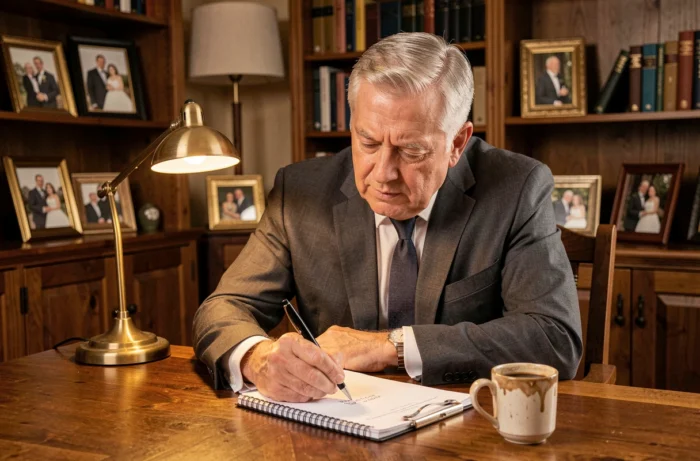
A parent’s speech that exceeds five minutes loses the audience’s attention. Feedback varies on this point depending on the format of the reception, but the ideal range is between two and five minutes for a parent. This corresponds to a text of about one handwritten page, read at a measured pace.
Timing alone is not enough. The real work consists of reading the text aloud, standing, in conditions as close to the big day as possible. Sitting in an armchair, one reads quickly. Standing, with a tight throat, one slows down, takes pauses, catches their breath. The same text can take a minute longer than expected.
Rehearsing standing and timing it three times gives a realistic duration. If the text exceeds five minutes in the third reading, it needs to be cut. The part to remove is always the same: the least personal section, the one that could appear in any parent’s speech.
Managing emotion at the microphone without losing the thread
Nerves are not the real risk. What destabilizes a parent at the microphone is the unexpected surge of emotion over a word, a phrase, a glance at their son. The voice breaks, the text becomes unreadable, silence ensues.
Some concrete techniques reduce this risk:
- Identify in advance the passages with strong emotional charge and pause just before, not during. Breathe, then read the sentence in one go
- Print the text in large font with wide line spacing. When the eyes blur, a well-spaced text remains legible
- Have a plan B: if emotion cuts off the voice, look up, smile, and let a few seconds pass. The audience understands. Pick up where you left off, without apologizing
- Avoid looking at the groom constantly. Alternating between the audience and your son helps manage emotional intensity
Include the daughter-in-law without disrupting the speech
A classic pitfall: dedicating the entire speech to one’s son, then adding a welcome phrase to the daughter-in-law at the end, like a postscript. She feels it, and so do the guests.
Integrating the couple into the central anecdote naturally resolves the issue. Share the moment when you realized this relationship was changing something in your son. Describe a detail observed during a first meeting or a family meal. Welcoming the daughter-in-law comes through a lived scene, not a polite formula.
A speech that addresses only the groom while forgetting the person he is marrying misses its target. The couple is at the center of the big day, and the text must reflect this reality without forcing an artificial balance between the two names.
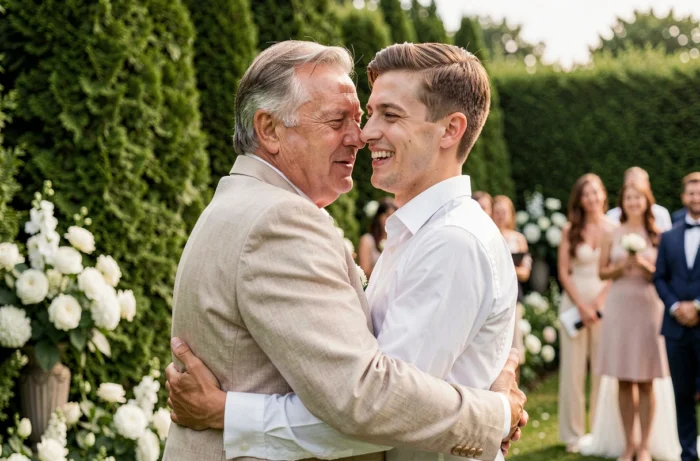
The last point to keep in mind: a good wedding speech for one’s son is not measured by its length or the amount of tears it provokes. It is measured by the precision of a shared memory, the attentive silence of the room over a true sentence, and that look between a parent and their child that says more than any prepared text.