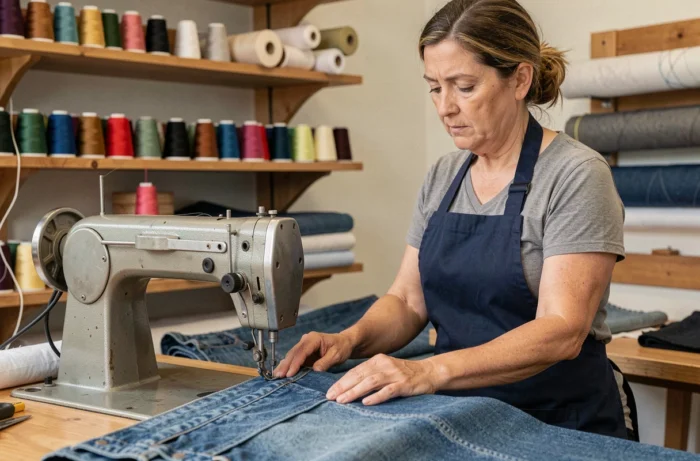
The ability of a machine to sew through layers of denim or oilcloth is not just about the power stated on the product sheet. We regularly observe machines boasting a generous motor but unable to maintain a consistent stitch on six layers of denim due to a lack of overall mechanical balance. Choosing the best sewing machine for thick fabrics requires thinking in systems: feed mechanism, presser foot, needle, and thread tension form a cohesive unit.
Presser foot lift height and feed mechanism: the two criteria that technical sheets overlook
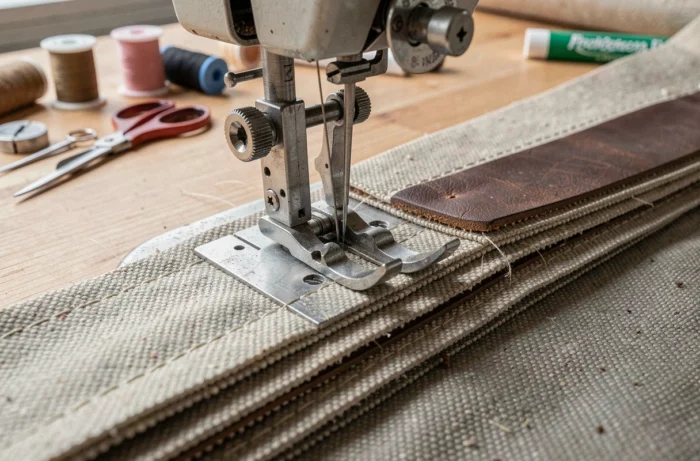
A powerful motor never compensates for a presser foot that does not lift enough. On an assembly of four layers of denim folded at the hem, the thickness under the foot can far exceed what an entry-level machine can handle. If the foot does not rise sufficiently, the fabric compresses, the feed dogs slip, and the stitch skips.
We recommend systematically checking the maximum presser foot lift height before any purchase. On mid-range home machines, this value often hovers around six to seven millimeters. Models designed for heavy-duty work offer significantly higher lift, sometimes double.
The second discriminating criterion is the type of feed mechanism. A feed mechanism with only feed dogs is not sufficient for rigid materials. Standard feed dogs pull the fabric from underneath, but on stiff leather or thick canvas, the top layer slips relative to the bottom layer. The result: misaligned seams and an uneven finish.
Finding the best sewing machine for thick fabric involves examining this feed mechanism long before considering the list of decorative stitches. Dual feed or triple feed machines (feed dogs, needle, upper foot) maintain consistent traction across the entire thickness of the textile sandwich.
Needle and thread tension: critical adjustments for heavy work
A standard size 80 needle breaks or bends at the first layers of faux leather. For thick fabrics, we work with needles sized 100 to 110, even 120 for genuine leather. The needle point is as important as the size: a round point is suitable for tightly woven denim, while a sharp point (like for leather) pierces non-woven materials without tearing them.
Check that the machine accepts these larger needle sizes. Some entry-level models are only compatible with needles up to size 90, which effectively excludes heavy-duty work.
Thread tension and stitch consistency
On thick fabric, the upper thread tension often needs to be increased so that the loop knot forms in the center of the thickness rather than on the surface. A machine whose tension disc lacks adjustment range will produce loose stitches on the underside. We frequently observe this defect on low-end electronic machines where the tension is managed automatically without the possibility of manual override.
Fine adjustment of the tension remains essential on dense materials. Machines that offer direct access to the tension disc, with a wide range and progressive increments, yield better results than those that fully automate this parameter.
Mechanical or electronic machine for sewing denim and faux leather
For heavy work, the mechanical machine retains a structural advantage. At an equivalent budget, its motor is generally more powerful, as the manufacturer has not invested in the screen, decorative stitches, or connectivity. Motor torque is the force of the needle penetrating the fabric, and this is precisely what is most lacking when facing a sandwich of thick canvas.
- The mechanical machine provides direct access to all adjustments (tension, stitch length, foot pressure), without menus or navigation through a screen. In a series alteration workshop, this time-saving is significant.
- The electronic machine offers automatic stop stitch, memory of settings, and sometimes a thickness sensor that adjusts foot pressure. For varied projects alternating between thin and thick fabrics, this versatility is justified.
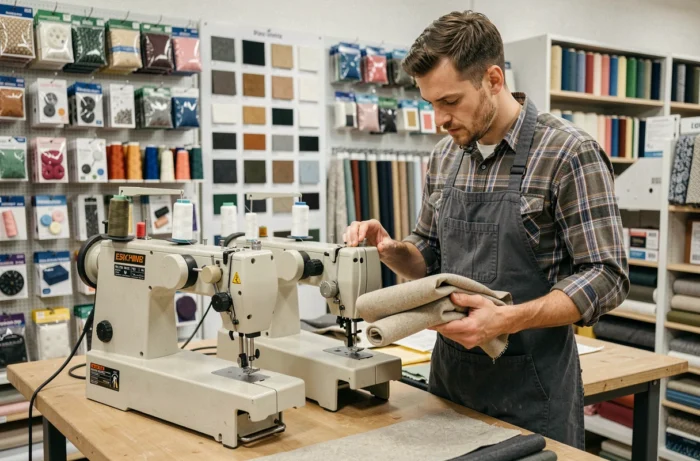
- Semi-industrial machines (flatbed sewing machines) constitute a third choice for those who exclusively sew heavy materials. They offer a triple feed and high sewing speed, but only do straight stitching.
The choice depends on the actual volume of sewing on thick materials. A few hems of denim per month do not justify a flatbed sewing machine. In contrast, a leather goods or saddlery workshop that works with leather daily will gain reliability and longevity with a semi-industrial or industrial machine.
Accessories for thick fabrics: Teflon foot, roller foot, and compensating plate
Even on a properly sized machine, specific accessories make a difference. The Teflon foot eliminates sticking on materials that cling (faux leather, coated fabric, vinyl). Without it, the fabric sticks to the standard metal foot and advances in jerks, distorting the stitch.
The roller foot serves a similar function, with an added advantage: it facilitates the passage over localized thicknesses (seam intersections, folded edges). The roller rolls over the bump instead of hitting against it.
Compensating plate for thickness discrepancies
When the foot moves from a thick area to a thin area (typically, the edge of a denim hem), it tilts and loses contact with the feed dogs. The compensating plate, placed next to the thickness, keeps the foot level and ensures constant feeding even at thickness transitions.
This is an accessory rarely provided as standard, but its impact on stitch consistency is immediate. We recommend acquiring it at the same time as the machine.
Test the machine with your own fabrics before buying
Technical specifications tell only part of the story. A machine that struggles, skips stitches, or vibrates abnormally on your own sample of leather or tarpaulin reveals its limits much more clearly than a product sheet. Bring your fabric scraps to the retailer and sew a sample on multiple layers. Listen to the motor: a marked slowdown or a forcing noise indicates that the machine is working at its limit.
Also think in terms of actual monthly sewing hours rather than project ambition. A high-end home machine is more than sufficient for a few hours a week on denim. Beyond that, the mechanical longevity of a semi-industrial machine is fully justified.