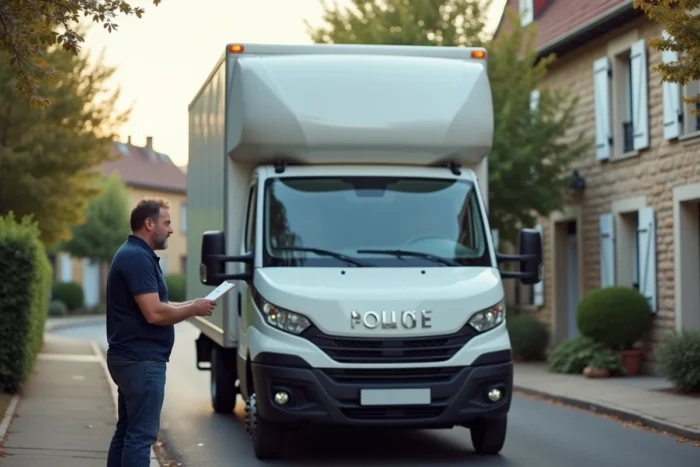
A 12m3 truck remains the most common format for urban moving or large deliveries under a B license. Its design meets a specific regulatory constraint: to stay below the gross vehicle weight (GVW) limit of 3.5 tons, which conditions its dimensions, payload, and the type of license required.
GVW, empty weight, and actual payload of a 12m3 van
The key data of a 12m3 truck is not its volume, but its GVW capped at 3.5 tons. This limit determines everything else: empty weight, usable payload, and compatibility with the B license.
On most rental models, the empty weight hovers around two tons. This leaves an effective payload of about one ton to one and a half tons, depending on the onboard equipment (tail lift, double partition, additional seats). We regularly observe a gap between the payload advertised on the commercial sheet and what is actually available once the fuel tank is full and the driver is on board.
In practice, a load of heavy furniture (appliances, oak bookshelf, convertible sofa) can push a 12m3 into overload well before the volume is filled. Before looking for the dimensions and capacity of a 12m3 truck, we recommend checking the payload listed on the vehicle’s registration certificate (box F2 minus box G1), not on the rental company’s website.
External and internal dimensions: what 12m3 really means
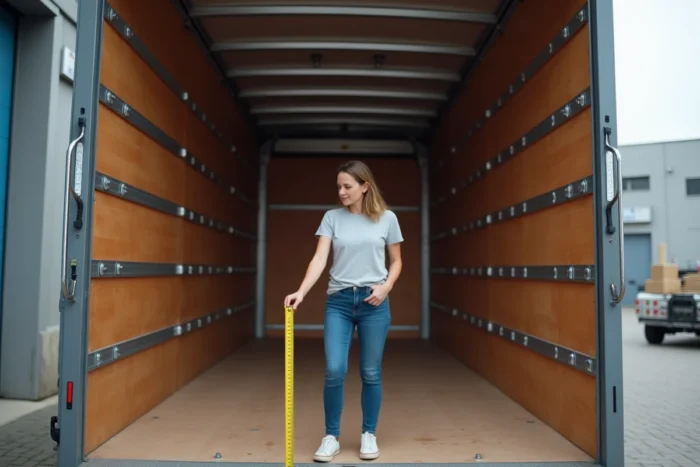
The advertised volume of 12m3 corresponds to the theoretical volume of the loading area, calculated by multiplying the internal length, width, and height. In practice, wheel arches, wall reinforcements, and the shape of the roof reduce the usable volume.
Typical internal dimensions
Vans in this category generally have a floor length of around 3 meters, a usable width between the wheel arches slightly less than 1.80 meters, and a ceiling height of about 1.80 to 1.85 meters. These dimensions vary according to the manufacturer and the exact model.
The internal height deserves special attention. Standing up in a 12m3 is only possible for a person measuring less than about 1.80 meters. Beyond that, loading is done bent over, complicating the handling of heavy boxes at the back of the loading area.
External dimensions and traffic constraints
The overall size often exceeds 5.90 meters in length and 2.40 meters in width. The overall height is around 2.80 meters. These dimensions pose two concrete problems:
- Underground parking is generally limited to 1.90 meters in height, which excludes any covered parking with a 12m3
- Narrow streets in historic city centers, often limited to 2 meters wide, become impractical without folded mirrors
- Some low-emission zones (LEZ) may restrict access based on the vehicle’s Crit’Air sticker, a point rarely checked before rental
B license and 12m3 truck: the real limits of the regulation
The B license is sufficient to drive any vehicle whose GVW does not exceed 3.5 tons. A rented 12m3 van falls into this category. No additional license is required, nor specific training.
The nuance lies in the conditions imposed by rental companies, which go beyond the highway code. Most require a minimum of three years of license experience. Some accept young drivers (one year of license) for an additional insurance fee and a higher deductible.
Towing and B96 or BE license
If you tow a trailer with a 12m3, the calculation changes. The B license allows for a towing combination where the sum of the GVW of the vehicle + GVW of the trailer does not exceed 4.25 tons. Beyond that, the B96 license (7-hour training, no exam) or the BE license (practical exam) becomes mandatory.
For a 12m3 with a GVW of 3.5 tons, this allows for a maximum trailer weight of 750 kg with a simple B license. With B96, the trailer can go up to a combined GVW of 4.25 tons. The BE license pushes this limit to 7 tons combined, but rarely concerns occasional moving use.

Overload and road control: the underestimated risk of the 12m3
Overloading a utility vehicle is a 4th class offense. The police can weigh the vehicle during a road check, and exceeding the GVW results in a fine, immobilization of the vehicle, and potentially a refusal of coverage by insurance in the event of an accident.
The trap of the 12m3 lies in its volume/payload ratio. With a loading volume comparable to that of a small furnished studio, it’s easy to fill the loading area without reaching the weight limit. The opposite is also true: a few appliances and a dozen boxes of books are enough to approach the ton of available payload.
We recommend weighing the heaviest items before loading, or at least estimating their total weight. A washing machine, refrigerator, and dishwasher alone represent a significant part of the available payload.
Fuel consumption and range on a moving trip
A 12m3 diesel van consumes more than a passenger vehicle, especially in the city and at full load. Driving in urban areas, with frequent stops and parking maneuvers, significantly increases consumption compared to a highway trip.
The tank of a 12m3 provides sufficient range for most intra-urban moving trips or between two nearby cities. On a trip of several hundred kilometers, a fuel stop should be expected, especially if the vehicle is loaded to full capacity.
A often overlooked point: rental companies charge for missing fuel upon return at a rate higher than that at the pump. Returning the vehicle with the same fuel level as at departure avoids this overcharging.
The 12m3 truck remains the best compromise between loading volume, urban maneuverability, and accessibility with a B license. The real limit of this format is not the volume, but the payload. Checking the GVW listed on the registration certificate before each loading protects both the driver and the contents of the move.