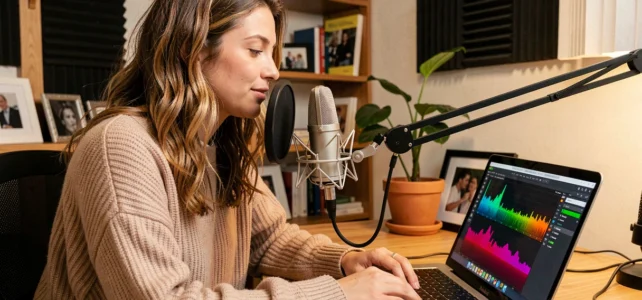
Putting your voice on music using AI relies on a precise technical sequence: voice recording, training a model, and then applying that model to an instrumental. The available tools vary in the quality of the output, the training time required, and the legal constraints that have recently come into effect in Europe. Comparing these parameters allows you to choose the solution that suits your level and usage.
Vocal separation and input quality: the factor that tools do not highlight
Even before cloning a voice or applying it to a track, the quality of the source audio file determines the final result. A recording with background noise, reverb, or instrumental overlap degrades the trained vocal model.
Most platforms recommend providing clean vocal audio, without effects or background music. OpenMusic specifies that you need at least ten minutes of isolated vocal audio to obtain a usable model. Less training data means a vocal clone that loses the nuances of timbre, note attacks, and transitions between registers.
For those who want to understand how to put their voice on AI music, this audio preparation step is often underestimated. A conference headset does not produce the same result as a condenser microphone in a quiet room, even if AI partially compensates for the flaws.
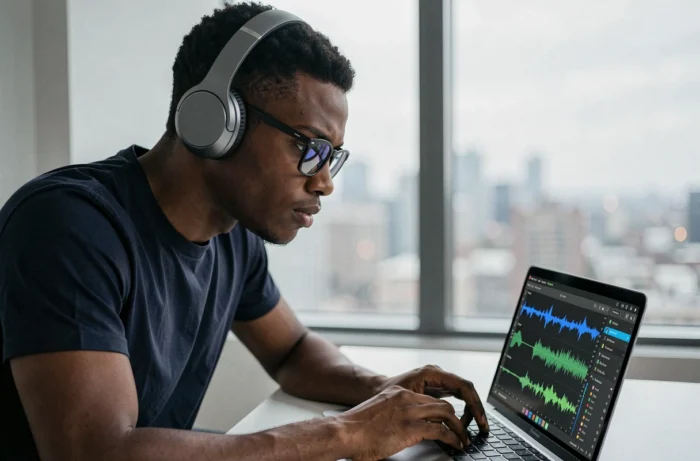
Track separation (isolating the voice from an existing piece) is also part of the process. Tools like LALAL.AI specialize in this extraction. The principle: retrieve the instrumental on one side, the voice on the other, and then replace that voice with the AI clone.
Comparison of AI tools for putting your voice on music
The platforms do not all offer the same pathway. Some manage the entire chain (vocal training + application on instrumental), while others cover only one step.
| Tool | Main function | Custom vocal training | Track separation |
|---|---|---|---|
| Kits.ai | Voice conversion and model creation | Yes | Yes |
| OpenMusic | AI sung voice and covers | Yes (recording or import) | Not integrated |
| Voicify | Covers with AI voice | Pre-created models | Not integrated |
| LALAL.AI | Vocal/instrumental separation | No | Yes (specialty) |
| Suno AI | Generation of complete songs | No | No |
Kits.ai and OpenMusic are the only two platforms in this comparison that allow training a model on your own voice and then applying it to an instrumental. In contrast, Suno AI generates entire pieces from textual descriptions, without the possibility of incorporating a personal vocal clone.
Complete chain or tool assembly
The most common pathway combines two or three services: a track separation tool to isolate the instrumental, a vocal training tool to create the model, and then a conversion step. No free platform perfectly covers all three steps with a professional output.
Kits.ai claims a royalty-free output on voices created via its models. This point becomes crucial for anyone publishing the result on a streaming platform.
European regulation on AI voices: what changes for creators
Since August 2, 2026, the European AI Act mandates through its Article 50 that any audio generated by AI must include a technical marking (watermark, metadata) allowing identification of its artificial origin. Vocal deepfakes must be labeled to the public as artificial content.
This obligation directly affects vocal cloning and voice-to-song conversion platforms. Their audio outputs must be technically identifiable as AI-generated, even if the end user does not perceive this marking while listening.
Vocal cloning and consent: a persistent gray area
Article 50 does not create any ownership rights over the voice and does not require the consent of the person before cloning. It also does not provide a specific right of withdrawal against already published clones. A creator can technically train a model on a third party’s voice without explicit permission, as long as the result is properly labeled as AI.
This situation creates a gap between the obligation of transparency (strict) and the protection of vocal identity (almost non-existent at the European level). Artists whose voices are cloned without agreement have no dedicated recourse under the AI Act.
Distribution on Spotify and streaming platforms: new restrictions
Spotify announced in August 2026 that it will label “AI persona” profiles and exclude their music from algorithmic recommendations. A piece sung by an AI vocal clone will therefore not receive the same visibility as a track performed by a human artist.
This policy distinguishes two cases:
- A human artist who uses AI as a production tool (vocal effects, harmonization) will be treated normally by the algorithm
- An entirely artificial profile, where the main voice is an AI clone without a real artist behind it, will be labeled and limited in playlists
- Pieces generated entirely by AI (text, melody, voice) are subject to even more restrictive treatment regarding recommendations
For a creator who wants to put their cloned voice on an instrumental and distribute the result, the distinction is clear: using AI on their own voice remains commercially viable, provided that the artist profile is indeed that of a real person.
Preparing a vocal recording usable by AI
The success of the process largely depends on the initial capture. A few technical criteria condition the quality of the trained model:
- Record in a room without echo, ideally acoustically treated or at least with thick fabrics around the microphone
- Prefer a non-compressed audio format (WAV) over MP3, which removes frequencies useful for training the model
- Vary vocal registers during recording: chest voice, mixed voice, high passages, so that the model covers the entire spectrum
- Avoid any processing (compression, equalization, auto-tune) on the source file before submitting it to the training tool
A clean and varied file produces a vocal clone capable of following complex melodies without audible artifacts. AI tools compensate for some flaws, but do not replace careful capture beforehand.
The technical and legal framework is evolving rapidly. Tools are becoming more precise, European regulation imposes transparency, and streaming platforms are adjusting their visibility rules. Mastering the quality of your source recording remains the lever over which every creator retains total control, regardless of algorithmic or regulatory developments.