
Between rising fixed expenses and accumulating daily purchases, accurately measuring where each euro goes allows for real margins to be identified. Saving money daily does not rely on general deprivation but on identifying areas where the gap between what we pay and what we could pay is the widest.
Cost gap between common habits and direct alternatives
Before making any changes, it is essential to quantify. The table below contrasts frequent habits with their most accessible alternatives, to visualize where the most significant savings margins lie over a typical month.
| Expense Category | Common Habit | Direct Alternative | Estimated Gap |
|---|---|---|---|
| Takeaway Coffee | Daily purchase at a bakery or café | Homemade preparation (thermos) | Reduction of more than half the monthly budget |
| Lunch Meals | Restaurant or takeaway | Batch cooking on Sunday | Halving or tripling the cost per meal |
| Digital Subscriptions | Three to five active streaming services | Monthly rotation (only one active at a time) | Elimination of two-thirds of the expense |
| Grocery Shopping | Shopping without a list, premium brands | Pre-established list, store brands | Notable decrease in average spending |
| Home Energy | Constant heating, active standby | Programmable thermostat, switchable power strips | Significant reduction in the annual bill |
What stands out from this comparison is that food expenses and subscriptions account for the most significant gaps. Energy expenses follow, with savings that are mainly noticeable over time.
To explore other savings levers categorized by type, a useful resource: https://economiz.fr/.
Subscriptions and recurring expenses: the most underestimated category
Most households accumulate automatic withdrawals that they have lost track of. Video streaming, music, cloud storage, gym memberships, internet packages, mobile insurance: each line taken in isolation seems modest.
When added together, they often represent an expense category comparable to grocery shopping. Listing all automatic withdrawals over three months almost always reveals duplicates or unused services.
Rotation instead of total cancellation
Cancelling all subscriptions is neither realistic nor desirable. However, activating only one streaming service per month (and alternating) divides the annual bill by the number of services to which one was subscribed simultaneously. The same principle applies to digital magazines or premium apps.
Energy and telecom subscription comparators
Online simulators allow you to compare electricity, gas, and mobile plan offers. Changing energy suppliers or renegotiating a telecom plan rarely takes more than an hour and generates recurring savings month after month without additional effort.
Automated savings: payment rounding and scheduled transfers
Competing articles often mention automatic transfers to a savings account. Few address the rounding mechanisms offered by several banks and fintechs.
The principle is simple: each card payment is rounded up to the nearest euro, and the difference is deposited into a dedicated savings account. Over a month of regular transactions, automatic rounding generates passive savings without changing one’s lifestyle.
- Several neobanks like Revolut or Bunq offer this function directly integrated into the payment card, which can be activated in minutes from the app.
- Some traditional banks have developed similar options, sometimes coupled with cashback on specific spending categories (fuel, groceries, transport).
- The main advantage remains consistency: unlike a monthly transfer that can be postponed, rounding occurs with each purchase without intervention.
Combining a scheduled transfer at the beginning of the month with daily rounding creates two complementary savings flows. The first is predictable and planable, while the second acts as a safety net for variable expenses.

Grocery shopping: three concrete mechanisms that reduce spending
Grocery shopping remains the heaviest variable expense for most households. Three levers stand out for their measurable effectiveness.
Shopping list and meal planning
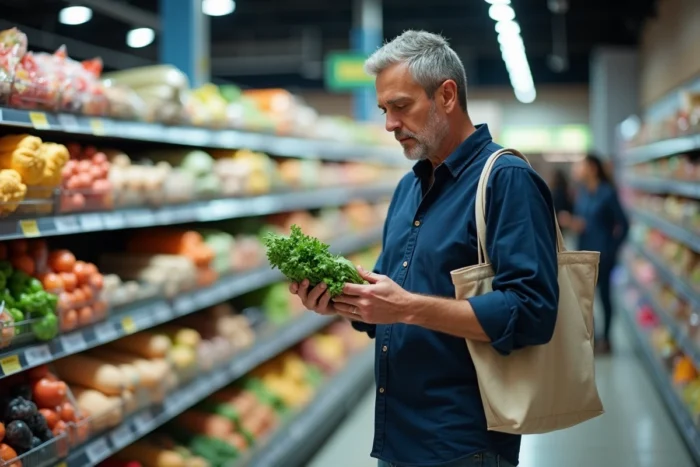
Preparing a weekly menu before grocery shopping eliminates unplanned purchases. Impulse buying represents a significant portion of the average basket in supermarkets. A strict list, combined with a checkout process that avoids non-relevant aisles, mechanically reduces the total.
Store brands and seasonal products
The price gap between a national brand and its store brand equivalent varies by product but consistently favors the latter. For fruits and vegetables, buying in season rather than imported out-of-season products reduces costs while increasing taste quality.
- Comparing the price per kilo (rather than the unit price) helps identify false good deals on family-sized formats.
- Anti-waste apps offer discounted baskets from local merchants at the end of the day.
- Freezing leftovers from batch cooking prevents waste and provides ready meals for busy weekdays.
Cashback on groceries
Some bank cards and dedicated apps offer a percentage back on grocery purchases. The amount recovered per transaction remains modest, but accumulated over a year, cashback covers the equivalent of several weeks’ worth of groceries.
Saving money daily relies less on willpower than on establishing systems that work without thinking about them. An activated payment rounding, a canceled unnecessary subscription, a respected shopping list: each automated mechanism removes a daily decision from the equation. The euros saved in these areas directly feed into savings that yield visible results over the months.